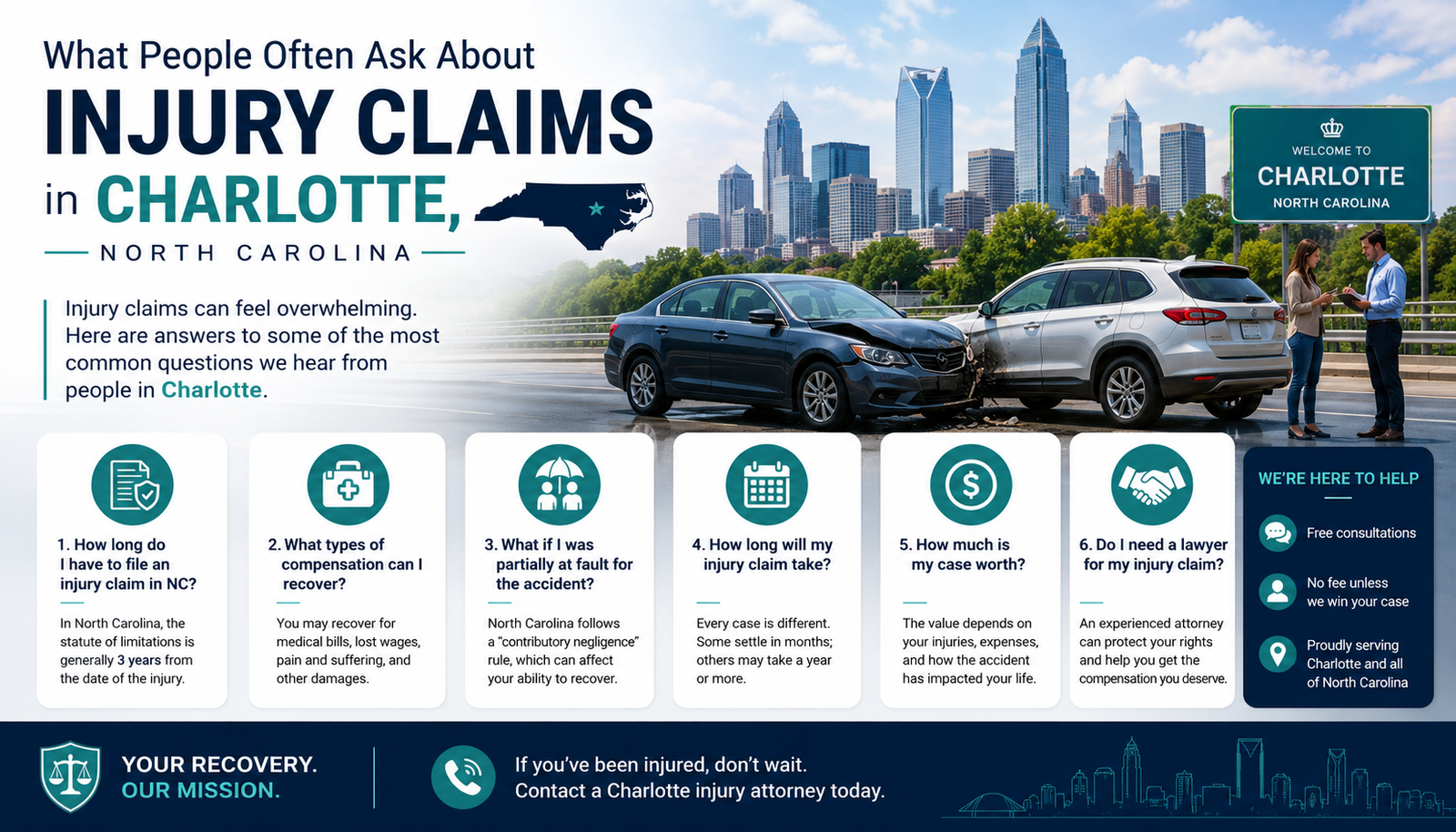
What People Often Ask About Injury Claims in Charlotte, North Carolina
The claims process usually starts with basic questions about what happened, who had the right of way, what each person could reasonably see, and whether anyone acted carelessly under the circumstances. When an injury happens in a confusing situation, families often want to understand how responsibility is sorted out before they make decisions about medical care, insurance calls, or whether to discuss settlement options with someone who understands the process.
For some families, the uncertainty is not just about who caused the accident, but about what to do next without making the situation harder. When medical appointments, missed work, repair issues, and insurance questions start piling up, it may feel practical to hire a personal injury law firm in Charlotte, NC to help sort through the facts and explain the process. That kind of guidance can be useful when responsibility is disputed, evidence needs to be preserved, or an insurance company is asking detailed questions before the injured person fully understands the claim.
Unclear conditions can make an injury claim feel harder than it should. A crash during heavy rain on I-77, a fall in a poorly lit store entrance, or an accident where both sides remember the facts differently may raise questions that are not answered by one document or one statement. As Attorney Matthew Fleishman has explained, “Responsibility often depends on the details people overlook at first.” That is why what people often ask about injury claims usually comes back to evidence, timing, and the practical steps that help clarify what really happened.
Article Brief
When responsibility is unclear, an injury claim is usually evaluated by looking at the conduct of everyone involved, the conditions at the time, and the evidence available after the incident.
- Responsibility is not always obvious right away.
- Photos, reports, witness details, and medical records can help explain what happened.
- Early decisions after an accident can affect how clearly the claim is understood later.
- Insurance companies may focus on uncertainty when reviewing fault.
- Good guidance can help families make steady choices during a stressful time.
How Responsibility Is Reviewed When the Facts Are Not Clear
After an accident, the answer to who is responsible often develops over time rather than appearing immediately. People may leave the scene with different impressions of what occurred, especially when the incident happened quickly or under stressful conditions. In personal injury claims, responsibility is generally reviewed by looking at whether someone failed to act with reasonable care and whether that failure contributed to the injury.
The problem is that real life rarely fits neatly into a simple explanation. A driver may say another car stopped suddenly, while the injured person may point to following too closely. A property owner may say a spill had just happened, while the injured person may believe the hazard was there long enough to be fixed. The solution is not guesswork. It is gathering details that help show what was known, what should have been known, and how the injury could have been prevented.
Why Unclear Conditions Can Complicate Injury Claims
Unclear conditions can make an injury claim harder because they give each side room to interpret the facts differently. Weather, lighting, traffic flow, damaged property, missing signs, and conflicting witness statements can all affect how responsibility is viewed. Even small details, such as the time between a hazard appearing and the accident happening, may matter.
Consider a parent driving home with children after a school event in Charlotte. Rain is coming down, traffic is moving slowly near an intersection, and another vehicle turns across the lane. After the crash, both drivers say they had the right to proceed. In that situation, responsibility may depend on traffic signals, vehicle damage, dash camera footage, nearby business cameras, witness statements, and the timing of each driver’s movement. No single fact may answer the question by itself, but several facts together can create a clearer picture.
What Evidence Helps Clarify Responsibility
Evidence helps separate assumptions from facts. Photos of the scene, vehicle positions, road conditions, visible injuries, damaged flooring, warning signs, and nearby cameras can help explain what happened. Medical records also matter because they connect the injury to the incident and show how symptoms developed after the event.
Witnesses can be especially useful when the people directly involved remember the accident differently. A neutral person who saw a vehicle run a light, noticed water on a store floor, or heard a warning just before the incident may help fill in gaps. Official reports can also provide important context, although they may not include every detail needed to evaluate the full claim.
How Early Decisions Can Affect the Claim
Many people focus only on the immediate aftermath, which is understandable. They may be trying to get home, care for children, arrange transportation, or decide whether to go to urgent care. Still, early decisions can affect how the claim is understood later.
Waiting too long to seek medical care may allow an insurance company to question whether the injury came from the accident. Giving a recorded statement without reviewing the facts may create confusion if pain, shock, or stress affected memory. Repairing property, throwing away damaged shoes, or failing to take photos can also make it harder to explain conditions that no longer exist.
Why Insurance Companies Ask So Many Questions
Insurance companies ask detailed questions because they are reviewing fault, damages, and coverage. Some questions are routine, but others may be designed to find uncertainty in the claim. When the facts are unclear, the insurer may focus on whether the injured person could have avoided the incident or whether another factor caused the harm.
This does not mean every question is unfair. It does mean answers should be careful, accurate, and based on what the person actually knows. Saying too much, guessing, or filling in details from memory can create problems. A steady approach can help protect the claim while still allowing the necessary review to move forward.
Finding Stability After an Injury Claim Starts
An injury claim can feel overwhelming when responsibility is being questioned, but the process becomes more manageable when the focus stays on documentation, medical care, and clear communication. Families do not need to solve every issue on the first day. They do need to avoid choices that make the facts harder to prove later.
For many people, the most practical step is to organize what they already have. Photos, medical paperwork, police or incident reports, insurance letters, repair estimates, and names of witnesses can all help create a timeline. That timeline may show how the injury happened, how symptoms changed, and why certain costs or limitations followed.
When Speaking With a Personal Injury Lawyer May Help
Speaking with a personal injury lawyer may help when there are conflicting stories, unclear conditions, serious injuries, or pressure from an insurance company. A lawyer can review the available evidence, explain what issues may affect responsibility, and help identify what additional information may be useful. This can be especially important when the injured person is also dealing with missed work, medical bills, or ongoing pain.
Rosensteel Fleishman Law Firm works with people in Charlotte who are trying to understand what comes next after an injury. A conversation with a firm like Rosensteel Fleishman can help clarify whether the claim may involve disputed fault, whether more documentation is needed, and how to communicate with insurance adjusters in a way that protects accuracy.
Keeping the Focus on Recovery and Clear Next Steps
The most important thing after an injury is creating enough stability to make informed decisions. That may mean following medical advice, keeping records, avoiding rushed statements, and asking questions before agreeing to anything that could affect the claim. Small steps can make the overall process feel less uncertain.
When responsibility is unclear, patience and detail matter. A claim is often built through careful review rather than quick assumptions. By preserving evidence, staying consistent with medical care, and getting reliable guidance when needed, injured people can protect their ability to move forward with a clearer understanding of their options.