United Flight UA109 Diversion Explained: What Really Happened
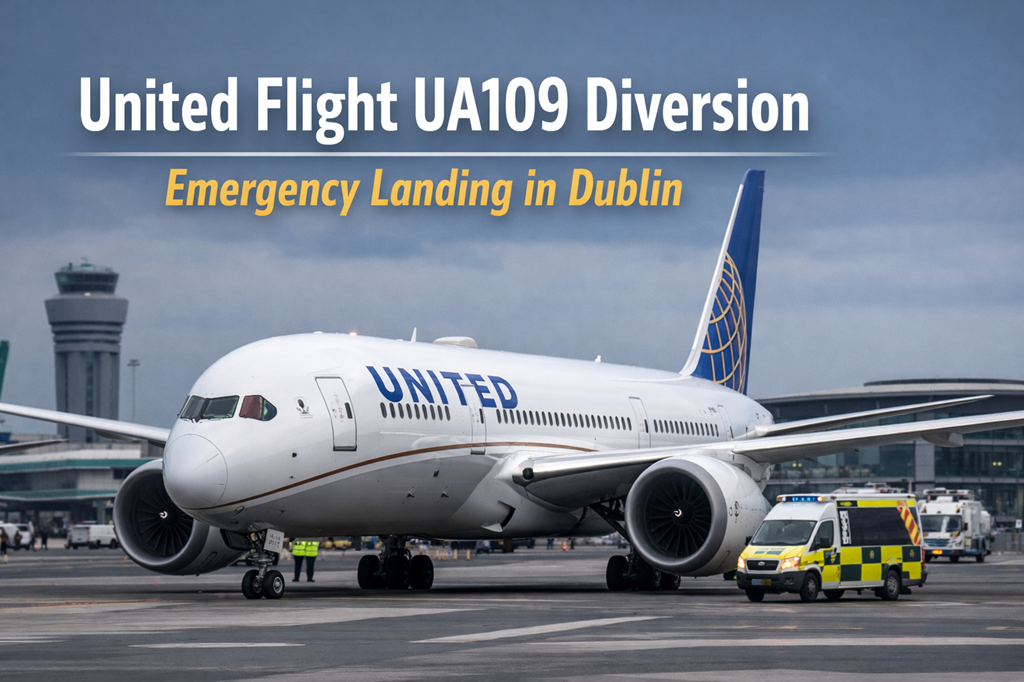
What Caused the United Flight UA109 Diversion
United Flight UA109 was diverted on October 30, 2025, after a medical issue involving a cabin crew member made it legally impossible to continue the transatlantic journey.
The aircraft diverted safely to Dublin, Ireland, where the crew member received medical attention before the flight continued to Washington Dulles with a short delay. The diversion was precautionary, regulatory, and not related to aircraft performance, passenger safety, or mechanical failure.
This article explains exactly what happened, why the diversion was required under aviation rules, how the situation was handled onboard, and what it reveals about modern airline safety procedures.
What United Flight UA109 Is and Why It Matters
United Airlines Flight UA109 is a scheduled long-haul international service operating between Munich Airport (MUC) and Washington Dulles International Airport (IAD).
This route is significant because it:
- Connects a major European aviation hub with the US capital region
- Operates almost daily year-round
- Carries a mix of government, business, academic, and leisure travelers
- Crosses extended North Atlantic airspace, where safety planning is especially strict
The flight is typically operated using a Boeing 787-8 Dreamliner, an aircraft certified for long-range overwater operations.
The Verified Facts of the October 30, 2025 Diversion
On October 30, 2025, UA109 departed Munich on schedule and climbed to cruising altitude before entering the North Atlantic portion of its route.
Several hours into the flight, a member of the cabin crew developed a medical condition that rapidly worsened, causing significant pain and loss of functional ability. The issue was later described in aircraft communications as a blister that became severe enough to prevent the crew member from working.
This was not a life-threatening emergency, but it directly affected flight safety compliance.
Why a Crew Medical Issue Can Force a Diversion
Cabin Crew Are Legally Required Safety Personnel
Cabin crew are not optional service staff. They are certified safety operators responsible for:
- Emergency evacuations
- Fire and smoke response
- Passenger management during abnormal situations
- First aid and medical coordination
International aviation regulations require a minimum number of medically fit crew members based on aircraft type and passenger load.
When one crew member becomes unfit for duty and no reserve crew is onboard, the flight may no longer meet legal safety requirements.
This Decision Is Not Discretionary
Once the crew member could not perform required duties, the flight could not legally continue across the Atlantic.
- This was not a comfort decision.
- This was not an airline preference.
- This was mandatory regulatory compliance under FAA and EASA standards.
Why the Aircraft Turned Back Toward Dublin
After evaluating the situation, the flight crew initiated a diversion to Dublin Airport (DUB).
Dublin was selected because it is:
- A certified ETOPS alternate for transatlantic flights
- Fully equipped for wide-body aircraft
- Capable of immediate medical response
- Strategically located along North Atlantic routes
At the point the issue occurred, Dublin was the closest airport that satisfied medical, regulatory, and operational requirements simultaneously.
Understanding the Mid-Atlantic U-Turn
The aircraft executed a controlled turn back toward Europe while still over the Atlantic.
This maneuver often draws attention on flight-tracking platforms, but it is a standard and pre-planned option for long-haul routes. ETOPS planning ensures that at every stage of the flight, at least one suitable diversion airport is reachable within defined time limits.
The turn was calm, deliberate, and fully coordinated with air traffic control.
What Happened After Landing in Dublin
Once on the ground in Dublin:
- Medical personnel met the aircraft
- The affected crew member was evaluated and treated
- Hospitalization was not required
- Passengers remained onboard during the stop
United coordinated documentation checks, crew compliance verification, and operational clearances before continuing the flight.
The aircraft then departed Dublin and resumed its journey to Washington Dulles.
Passenger Impact and Delay Reality
The total delay was slightly over two hours.
Passengers experienced:
- Clear communication from the flight crew
- No emergency procedures
- Completion of the journey on the same aircraft
- No reported safety concerns
While any delay is inconvenient, this event caused minimal disruption relative to the complexity of the situation.
Clearing Up Common Misunderstandings
The Aircraft Was Not Unsafe
There were no mechanical, technical, or structural issues with the aircraft. The Boeing 787-8 remained fully airworthy throughout.
The diversion was entirely unrelated to aircraft performance.
The Destination Was Not Boston
Some early online speculation incorrectly listed Boston as the intended destination.
This was false.
All verified flight plans and airline records confirm that Washington Dulles was the scheduled destination of UA109 on October 30, 2025. The confusion stemmed from misread flight-tracking data.
The Role of ETOPS in This Decision
ETOPS, or extended-range twin-engine operations, governs how aircraft like the Boeing 787 operate over oceans.
Key points:
- Diversion airports are selected before the flight departs
- Medical, runway, and operational capability are pre-evaluated
- Pilots follow predefined decision trees
Dublin’s role as the diversion airport was planned long before this flight ever took off.
The UA109 diversion followed ETOPS rules exactly as designed.
How Common Events Like This Really Are
Medical diversions occur daily worldwide. Most involve passengers. Crew-related medical diversions receive more attention because they directly affect regulatory compliance.
What matters is not how dramatic the issue sounds, but whether the aircraft can continue safely and legally.
In this case, it could not.
What United Flight UA109 Diversion Incident Reveals About Modern Aviation
The United Flight UA109 Diversion demonstrates several critical truths:
- Aviation prioritizes compliance over convenience
- Crew health is inseparable from passenger safety
- Diversions are preventive, not reactive
- Early decisions reduce long-term risk
Nothing about this event indicates failure. It indicates system discipline.
Why United’s Response Matters
From an operational perspective, United Airlines handled the situation correctly by:
- Supporting the pilot’s decision
- Coordinating medical care immediately
- Communicating clearly with passengers
- Resuming the flight efficiently
This is exactly how long-haul airlines are expected to respond to crew incapacitation events.
Final Perspective on the United Flight UA109 Diversion
The United Flight UA109 diversion was a required, safety-driven response to a crew medical issue that made continued flight non-compliant with international aviation regulations.
The aircraft was safe, the decision was correct, and passengers were protected at every stage.
For travelers, the takeaway is simple and reassuring.
When a flight diverts for reasons like this, it is not a sign that something went wrong.
It is proof that the system worked exactly as it should.