Top 7 Technology Leadership and Software Engineering Programs in 2026
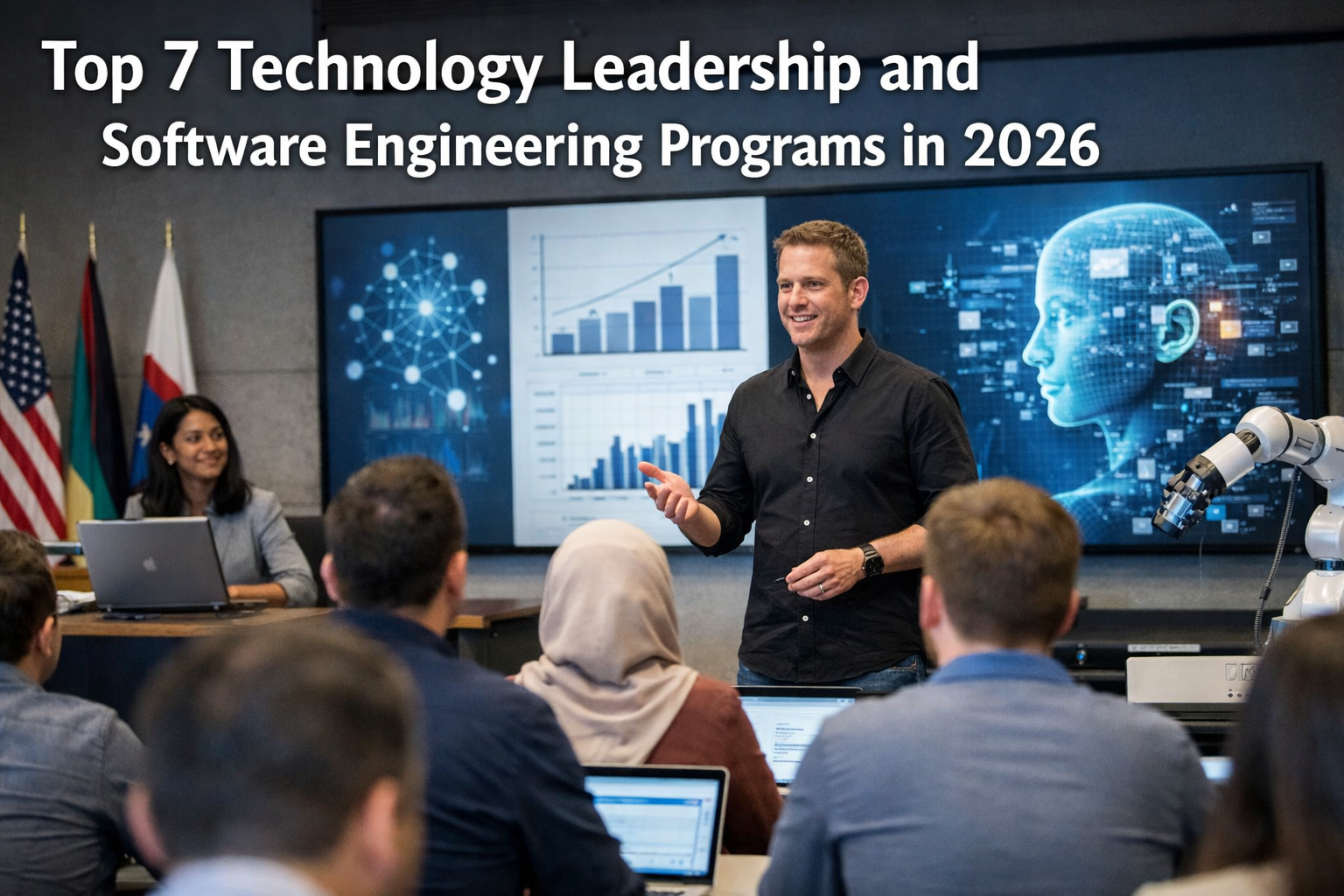
In 2026, technology leadership has shifted from pure management to an “engineering discipline.”
According to 2026 reports from Waydev and Deloitte, while 87% of tech leaders feel confident in their business outlook, a massive execution gap remains: only 11% of organizations have successfully moved agentic AI from pilot to production.
In this article, you will discover the top Technology Leadership and Software Engineering programs designed to bridge that gap and drive real, measurable ROI.
How We Selected These Tech Leadership Courses
- Focus on practical, real-world skills, not theory alone
- Alignment with tools, frameworks, or workflows used in 2026 (e.g., Agentic AI, Platform Engineering)
- Strong relevance to U.S. job market expectations
- Courses offered by reputable platforms, universities, or industry providers
- Emphasis on hands-on projects, exercises, or applied learning
Overview: Best Technology Leadership & Engineering Programs for 2026
| # | Program | Provider | Primary Focus | Delivery | Ideal For |
| 1 | Chief Technology Officer Program | The McCombs School of Business at The University of Texas at Austin | C-Suite Tech Strategy | Online | CTOs/VPs |
| 2 | Chief Technology Officer (CTO) Program | UC Berkeley Exec Ed | Strategic Tech Mgmt & AI | Hybrid | Senior Tech Execs |
| 3 | Chief Technology Officer (CTO) Program | Wharton (UPenn) | Scaling Tech & Business Strategy | Online | Aspiring CTOs |
| 4 | Engineering Leadership Professional Certificate | Stanford Online | Leading Technical Teams | Online | Eng Managers/Leads |
| 5 | Software Engineering Leadership | Carnegie Mellon (SEI) | Process Improvement & DevOps | Online/Hybrid | Software Architects |
| 6 | Cambridge AI Leadership Programme | Cambridge Judge | AI Strategy & Governance | Blended | Tech Directors |
| 7 | Digital Transformation Leadership | Imperial College London | Execution & Org Culture | Online | Digital Leads |
7 Best CTO and Software Engineering Courses in 2026
1. Chief Technology Officer (CTO) Program — The McCombs School of Business at The University of Texas at Austin
Overview
This comprehensive executive Chief Technology Officer Program prepares technology leaders to sit at the strategy table, moving them beyond IT management to enterprise architecture.
It covers the full spectrum of modern C-suite responsibilities, from managing technical debt to leveraging “Agentic AI” for hypergrowth.
- Delivery & Duration: Online, 9–12 months
- Credentials: Certificate from The McCombs School
- Instructional Quality & Design: Immersive “Modern CTO” modules and a real-world Capstone project.
- Support: Executive career coaching and alumni network access.
Key Outcomes / Strengths
- Align technology roadmaps with long-term corporate growth and M&A targets
- Navigate complex regulatory landscapes, including the EU AI Act and GDPR
- Design resilient organizational structures that support continuous innovation
- Communicate technical risks and opportunities effectively to the Board of Directors
2. Chief Technology Officer (CTO) Program — UC Berkeley Executive Education
Overview
Berkeley’s program is specifically designed for the “Silicon Valley” style of leadership. It emphasizes the CTO’s strategic role in driving product innovation and navigating the complexities of the modern tech stack, including cloud-native architectures and data privacy.
- Delivery & Duration: Hybrid (Online + Berkeley Campus Immersion), 10 months
- Credentials: Certificate of Excellence from UC Berkeley
- Instructional Quality & Design: Taught by industry veterans; focuses on “The CTO as a Business Leader” and includes a capstone strategy project.
- Support: Peer coaching groups and dedicated program mentors.
Key Outcomes / Strengths
- Align technology strategy with corporate financial goals
- Architect scalable systems for data-driven decision making
- Navigate the legal and ethical landscapes of AI and privacy
- Develop a personal leadership brand to influence the C-suite
3. Chief Technology Officer (CTO) Program — Wharton Executive Education
Overview
Wharton’s program bridges the gap between engineering and the boardroom. It focuses heavily on the economics of technology, how to evaluate buy vs. build decisions, how to measure technical debt in financial terms, and how to communicate ROI to non-technical stakeholders.
- Delivery & Duration: Online (with optional on-campus networking), 9-12 months
- Credentials: Wharton Executive Education Certificate
- Instructional Quality & Design: rigorous academic framework; covers “The AI Stack” and features electives in scaling businesses or M&A.
- Support: Global peer network and faculty office hours.
Key Outcomes / Strengths
- Master the financial language required for C-level technology discussions
- Evaluate emerging trends through a risk/reward investment lens
- Design organizations that support continuous innovation (CI/CD culture)
- Scale technology stacks from startup to enterprise levels
4. Engineering Leadership Professional Certificate — Stanford Online
Overview
This program is built for the “manager of managers.” It focuses on the specific challenges of leading high-performance engineering teams: managing technical debt, fostering psychological safety, and leading through influence rather than authority in matrixed organizations.
- Delivery & Duration: Online, Self-paced (approx. 3-6 months)
- Credentials: Professional Certificate from Stanford School of Engineering
- Instructional Quality & Design: Highly practical; focuses on specific frameworks for “execution excellence” and product-engineering alignment.
- Support: Course facilitators and peer discussion boards.
Key Outcomes / Strengths
- Master the “Art of the Technical Review” without micromanaging
- Build resilient engineering cultures that survive crunch times
- Bridge the communication gap between product and engineering
- Implement frameworks for scaling agile processes
5. Software Engineering Leadership — Carnegie Mellon University (SEI)
Overview
Rooted in the rigorous standards of the Software Engineering Institute (SEI), this program is ideal for leaders focused on software development processes.
It covers the architectural patterns, quality assurance standards, and DevSecOps practices necessary for mission-critical systems.
- Delivery & Duration: Online or Hybrid options, Flexible
- Credentials: Certificate from CMU/SEI
- Instructional Quality & Design: Technical and disciplined; focuses on metrics-driven management and “Software Architecture as Strategy.”
- Support: Access to SEI research resources.
Key Outcomes / Strengths
- Implement rigorous metrics for software quality and technical debt
- Lead the transition to DevSecOps and continuous delivery
- Architect systems for long-term maintainability and scale
- Manage complex software supply chains and vendor risks
6. Cambridge AI Leadership Programme — Cambridge Judge Business School
Overview
This program is critical for leaders who need to govern the AI revolution within their engineering teams.
It focuses on the strategic, ethical, and operational challenges of deploying AI agents, moving beyond the hype to practical implementation frameworks.
- Delivery & Duration: Blended (Online + Live Sessions), 4 months
- Credentials: Certificate from the University of Cambridge
- Instructional Quality & Design: Research-led; focuses on the intersection of policy, ethics, and technology strategy.
- Support: Tutor feedback and global cohort networking.
Key Outcomes / Strengths
- Design governance frameworks for “Agentic AI” systems
- Navigate the EU AI Act and global regulatory compliance
- Build diverse AI teams to mitigate algorithmic bias
- Assess the “build vs. buy” landscape for Generative AI tools
7. Digital Transformation Leadership — Imperial College London
Overview
Imperial’s program is designed for leaders tasked with modernizing legacy engineering organizations.
It focuses on the “people” side of transformation: upskilling workforces, managing resistance to change, and shifting from project-based to product-based operating models.
- Delivery & Duration: Online, 20 weeks
- Credentials: Verified Digital Certificate from Imperial
- Instructional Quality & Design: Simulation-based; places you in scenarios where you must make trade-offs between speed, quality, and culture.
- Support: Personal learning team and faculty interaction.
Key Outcomes / Strengths
- Execute the shift from “Project to Product” operating models
- Manage the cultural friction of digital transformation
- Design “Platform Engineering” teams to reduce cognitive load
- Measure the real business impact of engineering initiatives
Final Thoughts
In 2026, the best technology leaders are no longer just great coders; they are strategic architects of business value.
They understand that “shipping code” is secondary to “shipping outcomes,” and that software engineering eligibility is increasingly defined not only by technical proficiency, but also by leadership, business impact, and the ability to drive transformation at scale.
The top Technology Leadership and Software Engineering programs highlighted here provide the rigorous frameworks and executive presence needed to survive this shift, ensuring you remain a pivotal driver of measurable ROI in an AI-first world.