The Art of Falling Back Asleep: How to Handle the 3 AM Wake-Up Call

Waking up at 3 AM usually means one of two things: you are a superhero getting ready to save the world, or you are a normal person lying in bed feeling embarrassed about something you said ten years ago. If you are the second person, welcome to the “Midnight Anxiety Club.” Don’t worry, your brain isn’t broken. This is just your body’s natural survival system turning on at the wrong time.
Data shows that about 35% of adults have trouble staying asleep at least three times a week. The secret to falling back asleep isn’t about counting sheep. It is about sleep continuity—the ability to stay asleep without being woken up over and over.
To fall back asleep fast, you need to cool down your body and turn off your brain’s “alarm system.” If you stay awake for more than 20 minutes, your brain starts to think that being in bed means being awake. This creates a bad habit that makes it harder to sleep every night.
Why Is It Hard to Fall Back Asleep?
To solve the 3 AM puzzle, we need to look at what is happening inside your body.
Sleep Fragmentation
Sleep Fragmentation is the fancy name for waking up many times during the night.
Think of it like a scratched DVD. Every time the player hits a scratch, the movie stops or skips. Even if the movie finishes, the experience is messy and you feel tired afterward. By fixing these “scratches,” we help your sleep cycles run smoothly again.
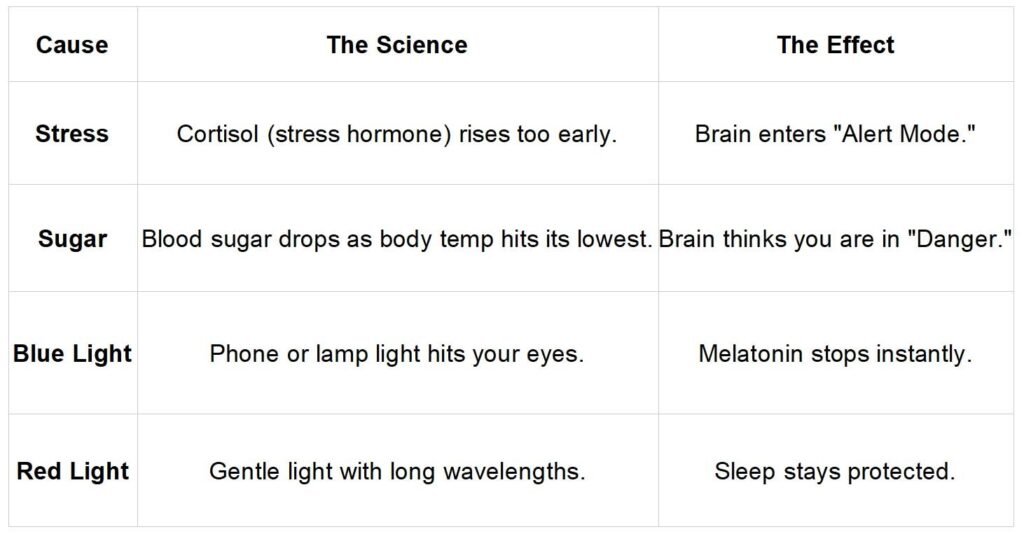
This happens for a few reasons. One reason is a change in hormones, especially for women. Another reason is a jump in cortisol, which is your body’s “stress hormone.” When cortisol rises too early, it tells your body to release sugar for energy. It’s like revving a car engine when the car is supposed to be parked.
The Problem with Light
The main reason people can’t fall back asleep is light. If you get up to go to the bathroom and turn on a regular bright light, you hit a “reset” button on your melatonin. Melatonin is the chemical that helps your brain stay asleep.
Standard light bulbs give off “blue light.” When this light hits your eyes, it tells your brain the sun is up. Your brain then stops making melatonin immediately, which “locks the door” to sleep.
The Science: Why Do We Wake Up?
Why does this always happen between 3 AM and 4 AM? It isn’t a mistake. It is a battle between your body’s internal clock and its need for balance.
The Blood Sugar Conflict: Around 3 AM, your body temperature is at its lowest. To get ready for the morning, your body starts making a little cortisol. If you are stressed or your blood sugar is uneven, your brain might panic. It thinks you are “hungry” or in “danger,” so it pulls you out of deep sleep.
The Light Experiment: Scientists at Harvard found that Blue/Green light (the kind from lamps and phones) stops melatonin even if it is very dim. However,Red light generally has less negative impact on sleep compared to blue light, and may even have some benefits for sleep quality when used properly before bedtime. This is why one look at a bright hallway light can ruin your whole night.
The Solution: The “3 AM Reset” Strategy
If you are staring at the ceiling, use these steps to get back to sleep.
1. Block the Light
This is your first line of defense. Your eyes have special cells that are very sensitive to blue light. Even one second of light can tell your brain to wake up.
What to do: If you have to get up, wear red sleep glasses with amber or orange lenses.
How it works: These glasses act like “armor” for your eyes. They block the blue light that wakes you up but still let you see where you are going. This tricks your brain into thinking it is still pitch black.
2. The 20-Minute Rule
A big rule in sleep science is: Don’t do anything in bed except sleep. If you lie there tossing and turning, your brain learns to feel stressed in bed.
What to do: If you aren’t asleep after 20 minutes, get out of bed. Go to a different room with dim lights and read a boring book.
How it works: This “breaks the link” between your bed and your anxiety. Only go back to bed when you feel very sleepy and your eyelids are heavy.
3. Warm Feet and a Cool Body
Your body temperature acts like a “start switch” for sleep.
What to do: Wear warm socks or wash your feet with warm water before going back to bed. Keep the bedroom cool (around 68°F or 20°C).
How it works: Warming your feet makes your blood vessels open up. This helps heat escape from the center of your body. When your “core” cools down, your brain automatically knows it is time for deep sleep.
“Sleep is not like a light switch that you can just snap on and off. It is much more like landing a plane. Your brain needs time to descend onto the runway of sleep.” — Dr. Matthew Walker, Neuroscientist and Sleep Expert
Conclusion: Work With Your Body, Not Against It
Waking up at 3 AM is just your body’s clock getting slightly off track. You can’t force yourself to sleep with willpower. Instead, you need to change the signals your body is getting.
The key to sleeping through the night is to stop fighting. When you manage the light around you and calm your nervous system, sleep happens naturally. Once you stop “trying” to sleep, your body’s natural healing system will take over and lead you back to dreamland.