Real Time Payment Fraud Prevention Strategies That Actually Work
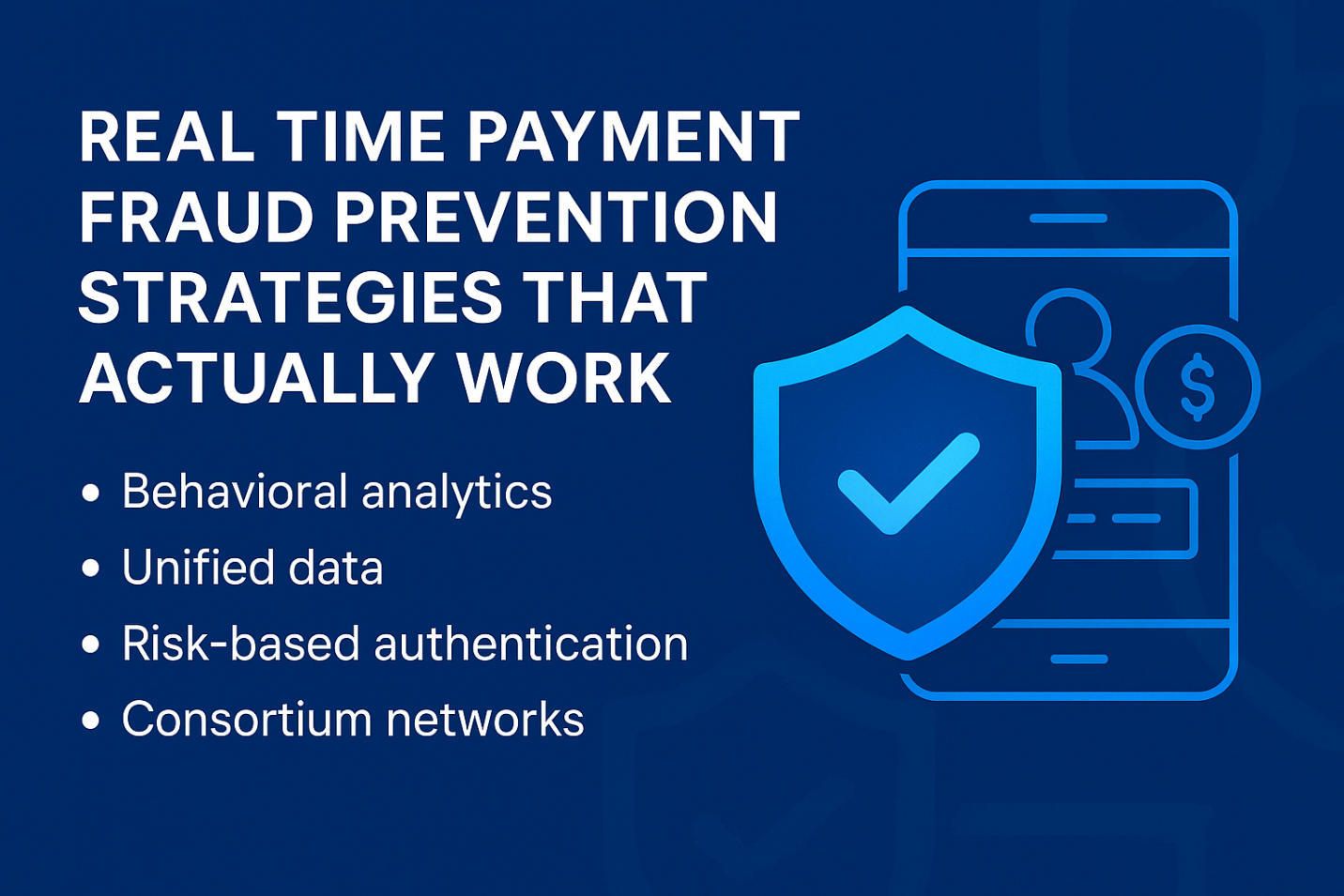
Real time payments have redefined the speed and convenience of financial transactions. Transfers that once took days now complete in seconds. This transformation has accelerated innovation across fintech, banking, gig economy payouts, payroll systems, and cross-border transfers. But the same speed that benefits customers also benefits fraudsters. Criminal activity now unfolds faster than traditional monitoring systems can respond, creating new risk pressures for financial institutions.
Fraud losses tied to instant payments continue to rise globally. UK Finance reported that losses from Authorized Push Payment (APP) scams reached more than £459 million in 2023, representing close to half of all fraud losses. In the United States, complaints involving peer-to-peer payment scams are increasing across platforms such as Zelle, Cash App, and Venmo. Regulators are publicly evaluating reimbursement requirements that shift responsibility toward payment providers instead of victims.
Stopping real time fraud requires more than incremental updates to legacy controls. Traditional rule-based systems were designed for batch settlement, where institutions have time to investigate, identify risks, and reverse transactions. None of those safety nets exist in real time environments. Without advanced, unified detection technologies, fraudsters gain unrestricted advantage.
The following deep-dive explores practical, proven strategies that financial institutions, fintech founders, risk leaders, and payment processors can adopt to strengthen real time fraud prevention while maintaining customer experience and compliance integrity.
Why Fraud Is Increasing Across Real Time Payments
Fraud networks are growing more sophisticated, well-coordinated, and data-driven. Three core factors contribute to rising fraud pressure in real time payment channels:
1. Instant settlement eliminates recovery windows
Once a transfer completes, it is irreversible. This creates a high-value target for cybercriminals and makes instant payments significantly harder to protect than card-based channels that allow dispute claims and chargebacks.
2. Fraudsters rely on social engineering rather than technical attacks
Instead of breaking into bank systems, attackers manipulate victims into initiating transfers themselves. They impersonate institutions through phone calls, spoofed SMS alerts, or remote desktop coaching. Because the customer authorizes the transaction, most traditional fraud filters accept it as legitimate.
3. Fraud networks move rapidly across platforms
Fraudsters exploit fragmented data environments. If one institution detects and blocks their activity, they immediately migrate to another platform where no shared intelligence exists.
To respond effectively, detection must be real time, context-aware, and powered by unified risk insights.
Key Question: How Can Institutions Detect Real Time Fraud More Accurately?
Traditional fraud systems depend heavily on historical patterns and fixed rules. While useful, they fall short against attackers who continuously change tactics. Real time fraud detection requires the combination of behavioral analysis, device intelligence, dynamic scoring, and contextual signals.
Modern systems unify:
- Behavioral biometrics
- Device and network telemetry
- Transactions and velocity patterns
- Identity confidence scoring across channels
- Relationship graph analysis
- Risk scoring that updates continuously
A detailed exploration of real time fraud detection in payment systems is covered in Detecting Fraud in Real-Time Payments, which explains why behavioral and device intelligence plays a critical role in stopping social engineering and APP scams at the moment of transfer.
Fraud prevention technology must evaluate risk continuously, not after funds move. When real time monitoring and unified risk scoring work together, institutions reduce false positives, improve accuracy, and act confidently — even under instantaneous payment deadlines.
Understanding Real Time Fraud Attacks in Practice
Below are examples of attack patterns seen across fintechs, challenger banks, and crypto platforms.
Authorized Push Payment (APP) scams
Victims are convinced to approve transfers directly. Attackers pose as:
- Bank security teams
- Government authorities
- Trusted businesses or partners
- Investment consultants
The victim completes authentication and manually sends the funds, making detection more difficult than credential-based fraud.
Remote access fraud
Fraudsters use remote control tools like AnyDesk, TeamViewer, or Zoom to guide victims step-by-step through submitting a transfer.
Synthetic identity creation
Partial real data blended with fabricated identity details creates accounts capable of surviving basic verification.
Money mule networks
Fraudsters recruit or trick individuals into transferring illegally sourced funds quickly across accounts.
Account takeover followed by rapid withdrawal
Compromised credentials lead to immediate maximum-value transfers.
Each pattern illustrates why legacy controls, batch-based monitoring, and manual review cannot stop real time attacks.
Practical Strategies That Strengthen Real Time Fraud Prevention
Below are proven methods financial institutions can implement to build stronger fraud defenses.
1. Use behavioral analytics and device intelligence
Fraudsters leave digital fingerprints through their device behavior and interaction patterns. For example:
- Copy-paste behavior vs natural typing
- Repetitive mouse movements or scroll patterns
- Emulator, virtual device, or automation signals
- Remote access flags or suspicious proxy activity
Legitimate users behave organically, while attackers behave efficiently. Behavioral biometrics identify this contrast without adding friction for customers.
2. Adopt real time risk scoring and streamed decisioning
Risk must update continuously from onboarding through transaction completion. Continuous scoring surfaces anomalies such as:
- First-time device paired with a high-value transfer
- Sudden change in payment recipients
- High-frequency or rapid escalations in amount
- Transfers leaving typical geographies
Real time scoring is critical in APP scams where identity itself appears legitimate.
3. Strengthen authentication around risky activities
Risk-based step-up controls can include:
- Verification delays when behavior changes noticeably
- Beneficiary name validation
- Secondary confirmation messages before large transfers
The UK’s Confirmation of Payee program significantly reduced misdirected and scam transfers by validating account names before payment execution.
4. Implement shared fraud intelligence and consortium networks
Criminal activity rarely targets one institution. Multi-platform collaboration allows:
- Rapid identification of emerging fraud typologies
- Shared negative lists and blocklists
- Faster tracking of mule accounts
Without shared models, fraudsters migrate freely.
5. Use automated case management and escalation workflows
Automation reduces operational load and improves response time. Real time payments do not allow analyst delays.
6. Strengthen onboarding controls
Early identity confidence prevents downstream losses. This includes:
- Identity and biometric verification
- KYB verification for business accounts
- Sanctions and PEP screening
- Beneficial ownership assessment
Most mule accounts originate from weak onboarding.
Regulatory Pressure Is Building Worldwide
Across major financial markets, regulators are aggressively assessing real time payment fraud accountability.
Examples include:
- UK Payment Systems Regulator introduced mandatory reimbursement for APP fraud victims beginning in 2024.
- CFPB in the United States is evaluating treating APP fraud as unauthorized under Regulation E.
- Europe’s Strong Customer Authentication rules require layered identity controls for high-risk payments.
- India’s UPI mandates device fingerprinting and real time fraud screening.
Regulators are sending a single message: faster payments require higher-precision protection.
Compliance expectations will continue to increase, and institutions that modernize early gain the opportunity to lead rather than react.
The Role of Unified Data Platforms in Real Time Fraud Defense
Fragmented technology systems limit risk visibility. When onboarding data, transaction records, device intelligence, and behavioral signals live in separate environments, blind spots grow. Unified platforms solve this fragmentation by consolidating all fraud and AML controls into a single system capable of real time decisioning.
Financial institutions using a modern AML compliance solution tied to unified data can reduce manual review volume, automate SAR workflows, centralize case management, and apply real time insights across channels. This level of integration is crucial for institutions operating across fintech, payments, and digital banking environments. More information on unified risk and monitoring solutions can be found at https://www.flagright.com/.
Unified systems outperform siloed stacks by delivering:
- Faster investigation
- Actionable insights
- Reduced false positives
- Lower operational cost
- Stronger compliance posture
- Better customer experience during growth
Balancing Growth and Security
Real time payments will continue expanding. McKinsey anticipates global instant payment volumes will more than triple before 2027. Businesses that handle payments must prepare to support frictionless user experiences while delivering uncompromising protection.
Security is not a barrier to scale. Security is how scale becomes sustainable. Customer trust is built through reliability and protection, not speed alone.
Investing in behavioral analytics, device intelligence, real time scoring, consortium collaboration, and unified risk platforms gives institutions the power to grow without exposing customers to harm.
Fraud prevention in real time payments is not just about stopping loss. It is about enabling confidence, supporting innovation, and strengthening the foundation of digital finance.
The institutions that build real time protection today will lead tomorrow’s financial landscape. Strengthening defenses is an opportunity to differentiate, not an operational burden. Faster payments deserve smarter security, and customers expect nothing less.