Nucleotides Explained: Their Role in DNA and RNA Functionality
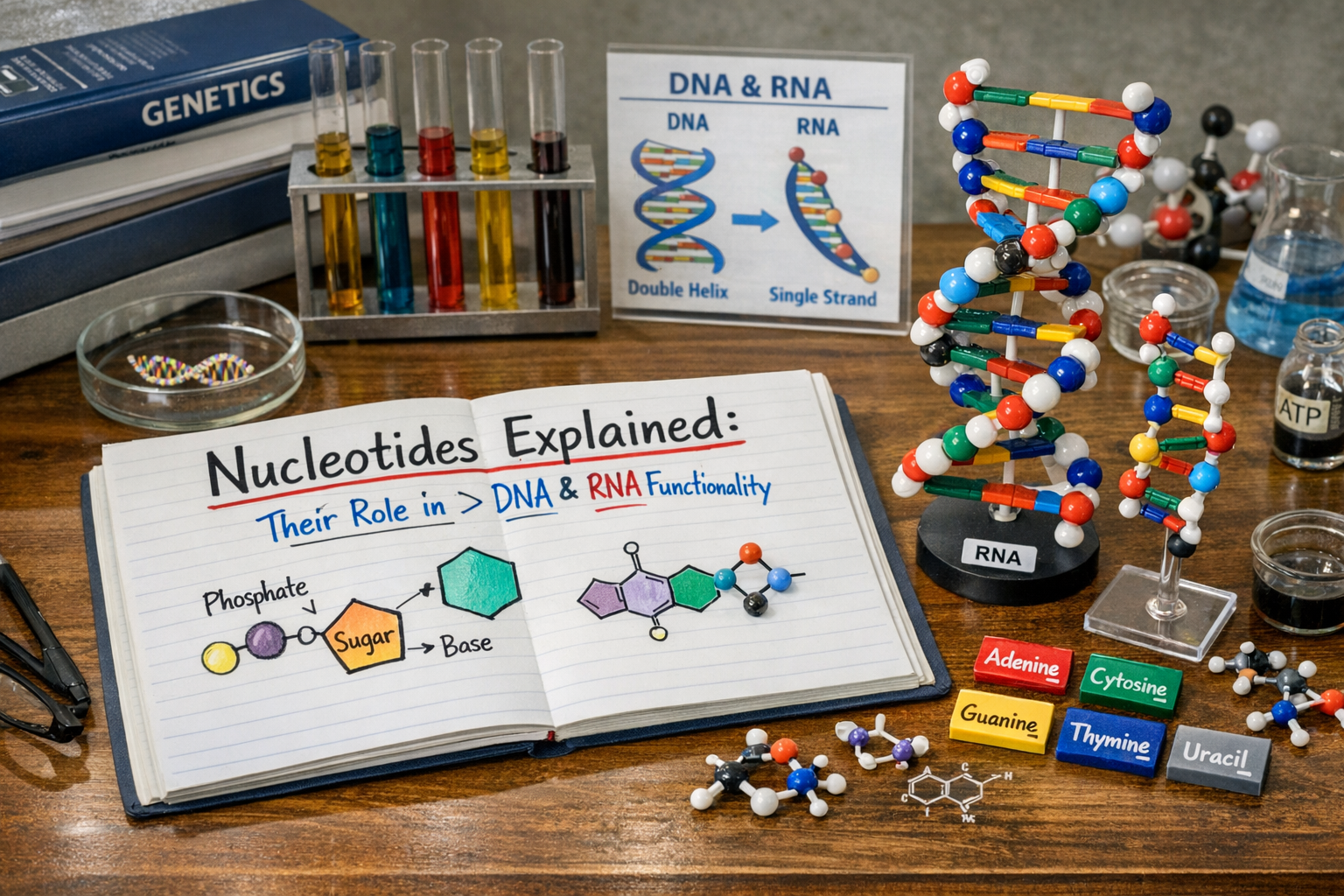
Did you ever wonder what makes up the very fabric of life? At the heart of every living organism lies a remarkable group of molecules known as nucleotides. These tiny building blocks are essential for DNA and RNA functionality, acting as the foundation for genetic information and cellular processes. Whether you’re delving into molecular biology or just curious about what fuels our biological engines, understanding nucleotides is crucial. Join us on this journey to unravel their structure, synthesis, and numerous applications that span from prebiotic origins to cutting-edge medical advancements!
Structure
Nucleotides consist of three key components: a nitrogenous base, a five-carbon sugar, and one or more phosphate groups. The nitrogenous bases can be classified into two categories—purines (adenine and guanine) and pyrimidines (cytosine, thymine, and uracil). These bases are critical for encoding genetic information.
The sugar component varies slightly between DNA and RNA. In DNA, the sugar is deoxyribose, while in RNA it’s ribose. This small difference has significant implications for stability and functionality within cells. Together, these parts form the backbone of nucleic acids that drive biological processes.
Synthesis
Nucleotide synthesis occurs through two primary pathways: de novo and salvage. The de novo pathway builds nucleotides from simpler molecules, utilizing amino acids, ribose-5-phosphate, and carbon dioxide. This process is complex but essential for cellular function.
In contrast, the salvage pathway recycles existing nucleotides by converting breakdown products back into usable forms. Both methods are crucial for maintaining adequate pools of dNTPs and rNTPs within cells, ensuring that DNA and RNA synthesis can proceed without interruption during replication or repair processes.
Quantification of dNTP pools
Quantifying dNTP (deoxyribonucleoside triphosphates) pools is crucial for understanding DNA synthesis and repair. Accurate measurements help researchers gauge the balance of nucleotide availability, which directly influences cell proliferation and genetic stability.
Techniques such as high-performance liquid chromatography (HPLC) or mass spectrometry are often employed to analyze these nucleotide concentrations. Monitoring dNTP levels can provide insights into cellular processes, including replication fidelity and response to stressors, making it a key aspect in molecular biology research.
Prebiotic synthesis of nucleotides
The prebiotic synthesis of nucleotides is a fascinating area of research that explores how these essential building blocks may have formed in the early Earth environment. Scientists propose various pathways, including reactions involving simple organic molecules under conditions mimicking primordial settings.
These processes likely involved energy sources like ultraviolet light or geothermal heat, facilitating the formation of ribonucleotides and deoxyribonucleotides from simpler compounds. Understanding this origin can provide valuable insights into life’s beginnings and the potential for life on other planets.
Unnatural base pair (UBP)
Unnatural base pairs (UBPs) expand the genetic code beyond natural nucleotides. Scientists design these synthetic bases to pair with existing DNA structures, creating unique and stable interactions. This innovation allows for more complex information storage in living organisms.
The potential applications of UBPs are vast, particularly in biotechnology and medicine. They can facilitate the development of novel drugs or enhance gene therapy techniques. By incorporating UBPs into DNA strands, researchers aim to improve specificity and reduce side effects in therapeutic contexts while advancing our understanding of molecular biology.
Medical applications of synthetic nucleotides
Synthetic nucleotides play a pivotal role in modern medicine. They are utilized in gene therapy, allowing for the precise editing of genetic material to correct disorders. This innovation opens new avenues for treating diseases that were previously deemed untreatable.
Moreover, synthetic nucleotides aid in vaccine development. By incorporating them into mRNA vaccines, researchers can enhance immune responses and design more effective immunizations against various pathogens. Their versatility also extends to diagnostic tools, making them invaluable in detecting viral infections and other conditions quickly and accurately.
Pyrimidine ribonucleotide synthesis
Pyrimidine ribonucleotide synthesis begins with the formation of orotate, a crucial precursor. This process involves multiple enzymatic steps, where carbamoyl phosphate and aspartate are converted into dihydroorotate.
Dihydroorotate then undergoes oxidation to yield orotate, which is subsequently linked to ribose-5-phosphate through a reaction catalyzed by orotidylate synthase. The pathway culminates in the production of uridine monophosphate (UMP), which can be further phosphorylated to generate UDP and UTP. These nucleotides play vital roles in RNA synthesis and energy metabolism within cells.
Purine ribonucleotide synthesis
Purine ribonucleotide synthesis is a critical process in cellular metabolism. This pathway generates essential nucleotides, namely adenine and guanine, which play pivotal roles in DNA and RNA formation. The de novo synthesis begins with simple precursors like amino acids, formate, and carbon dioxide.
The initial steps involve the creation of inosine monophosphate (IMP), serving as a key intermediate for both adenine and guanine production. Enzymatic reactions drive this intricate pathway forward, ensuring that cells maintain adequate nucleotide pools for replication and transcription activities vital to life processes.
Pyrimidine and purine degradation
Pyrimidine and purine degradation is a vital process in cellular metabolism. When nucleotides are broken down, their components are recycled or eliminated from the body. Pyrimidines like cytosine and uracil undergo deamination, leading to products that can enter various metabolic pathways.
Purines, including adenine and guanine, face a more complex breakdown involving several enzymatic steps. They are ultimately converted into uric acid for excretion. This process not only regulates nucleotide levels but also prevents accumulation of potentially toxic metabolites within cells.
Using Nucleotide
Nucleotides are essential for various biological functions. They serve as the building blocks of DNA and RNA, playing a key role in genetic information storage and transfer. Beyond this, they act as energy carriers in cells through molecules like ATP.
In addition to their natural roles, synthetic nucleotides have opened new avenues in research and biotechnology. These engineered molecules can be tailored for specific applications, such as gene editing or developing novel therapies. Their versatility makes them invaluable tools across many scientific disciplines.
Nucleotide Tools
Nucleotide tools are essential for researchers and professionals working with DNA and RNA. Various software applications assist in sequence assembly, alignment, and analysis. These tools can help identify mutations or variations within nucleotide sequences, facilitating advancements in genetics.
Laboratories also utilize physical tools such as gel electrophoresis equipment to separate nucleotides based on size. Additionally, PCR machines amplify specific DNA segments, enabling further study of genetic material. Together, these resources streamline research processes and enhance our understanding of nucleic acids’ complexities.
Other Resources
For those eager to delve deeper into the fascinating world of nucleotides, a variety of resources are available. Books such as “Molecular Biology of the Cell” offer comprehensive insights. Online platforms like PubMed provide access to cutting-edge research articles.
Websites dedicated to molecular biology can also serve as valuable tools for expanding your knowledge. Engaging with scientific communities on forums or social media can keep you updated on current findings and discussions in nucleotide research.
Whether you’re a student, researcher, or simply curious about these vital molecules, numerous avenues await exploration. Embrace them to enrich your understanding!