Kilt Hose Mistakes 90% of Tourists Make (And How Mens Kilts Scotland Locals Get It Right)
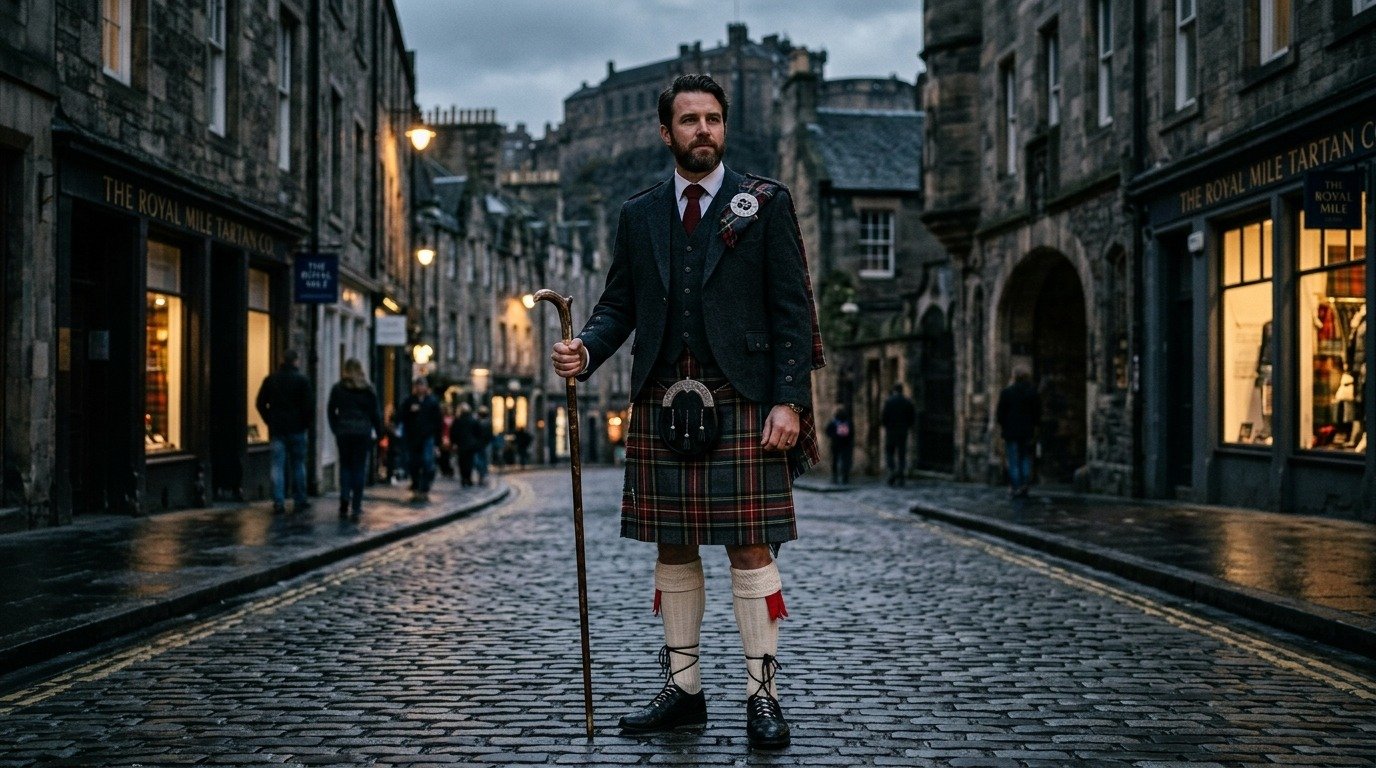
You can spot a tourist in a kilt from across Princes Street. It’s almost never the kilt itself that gives them away. The kilt is usually fine — bought from a reasonable shop, in a respectable tartan, fitted close enough. The dead giveaway is always lower down.
It’s the kilt hose.
The socks. The knee-high wool hose that complete the lower half of the outfit. Get them wrong and the whole kilt outfit reads as costume, no matter how good the kilt is. Get them right and you’ll pass for a local who’s worn this combination for decades.
After years of watching this pattern repeat itself at weddings, Highland games, and pubs across Edinburgh and Glasgow, I’ve put together the most common kilt hose mistakes — and the small adjustments Scottish locals make automatically.
Mistake 1: Buying Bright White Hose
This is the single most common error and the easiest to spot.
Tourists almost always reach for pure bright white kilt hose. They look clean. They photograph well. They feel formal.
But pure white hose are a uniform, not a fashion choice. They’re worn by:
– Scottish military pipe bands
– Specific Highland regiments
– Some pipe band competitions
That’s it. For everyday formal wear — weddings, ceremonies, dinners — pure white hose look out of place. The Scottish men you see at family weddings are wearing **off-white**, **cream**, or **ecru** hose. The difference seems subtle in product photos but is dramatic in person.
**The local fix:** Choose cream or natural-colored wool kilt hose. They have a soft, slightly yellowed undertone that flatters the legs and reads as classic rather than military.
Mistake 2: Going Black With Black Tartan
Many tourists try to “match” their kilt by wearing black hose with a Black Watch or other dark tartan. The reasoning makes intuitive sense — match dark with dark.
But this almost always looks heavy and stocky. The leg becomes one solid dark column from the knee down to the ground. The kilt’s pleats lose their visual contrast against the leg.
**The local fix:** Most Scottish men wear cream, off-white, or charcoal grey hose with their Black Watch — never matching the exact tartan colors. The contrast is what makes the leg shape visible and elegant. Charcoal grey is especially popular as a smarter alternative to cream without going all the way to black.
Mistake 3: Wearing the Hose Too High
Tourists often pull their kilt hose up under the kneecap because that feels secure and “proper.”
Locals don’t.
The traditional positioning is exactly **two finger-widths below the kneecap** — leaving a small visible band of skin between the kilt hem and the top of the hose. This gap is critical. It breaks up the leg visually and gives the entire outfit its proper proportion.
When the hose is pulled up high, the kilt and the hose visually merge into one continuous garment, which kills the kilt’s silhouette.
**The local fix:** Pull the hose up to approximately two fingers below your kneecap, then fold the cuff down a few inches. The fold sits naturally about four inches below the kneecap.
Mistake 4: Skipping the Cuff Fold
Lots of beginners pull their hose up straight without folding the top down.
Authentic kilt hose are designed with a knit pattern that’s meant to be folded. The fold creates a thicker, structured cuff at the top of the hose, which:
– Holds the garter elastic securely
– Provides the visual base for garter flashes
– Adds a more polished, finished look to the leg
A folded cuff is the difference between “I’m wearing tall socks” and “I’m wearing kilt hose.”
**The local fix:** Fold the top of the hose down about 4 to 5 inches. Make sure the fold is even on both legs. Tuck the garter strap into the fold so it’s hidden but holds the hose in place.
Mistake 5: No Garter Flashes

Many tourists buy kilt hose and assume that’s it. They walk out the door and don’t realize they’ve left out the colored ribbons that should peek out from the fold.
Kilt hose are typically sold with — or paired with — small flashes: short ribbons that hang down from the elastic garter inside the cuff. They serve a real purpose (helping anchor the elastic) and an aesthetic one (adding a small flash of color to break up the otherwise plain hose).
Without flashes, the leg looks unfinished. With flashes, it looks deliberate.
**The local fix:** Wear flashes. Match the color either to your tartan, your tie, or to a complementary accent color. Red is the most common universal color. Both legs should match exactly.
Mistake 6: Bunching Around the Ankle
Walking five minutes after putting on kilt hose and watching them slowly slide down to bunch at the ankles is a tourist tradition.
This happens for two reasons:
1. **The hose isn’t held up properly.** Quality kilt hose include or pair with elastic garters that wrap around the calf inside the fold of the cuff.
2. **The hose is the wrong size or weight.** Cheap synthetic hose stretches out within an hour of wear. Quality wool hose holds its shape.
**The local fix:** Use proper garters underneath the cuff fold. They should grip firmly but not painfully. If your hose still slides down, you need either better hose or smaller hose — not a different garter.
Mistake 7: Wearing Synthetic Hose
This one is less obvious but locals spot it instantly.
Cheap synthetic kilt hose has a particular sheen to it under photography flash and bright sunlight. The fabric looks slightly plastic. It also pills quickly and loses its shape after a few wears.
Wool kilt hose has a matte, slightly textured appearance. It absorbs light rather than reflecting it. It holds its shape over years of wear.
**The local fix:** Spend the extra $20 to $40 on wool or wool-blend hose. They look dramatically better in person and photograph correctly. Brands marketed for actual Scottish events almost always use wool. Tourist shops on the Royal Mile selling $15 hose are almost always synthetic.
Mistake 8: Mismatched Hose
Few mistakes look worse than two slightly different shades of cream or two different folds.
This usually happens because:
– The pair was bought separately
– The cuffs were folded inconsistently
– One sock has stretched out more than the other from wear
**The local fix:** Always buy hose as a matched pair. Always fold both cuffs to the same depth. Replace both hose at the same time when one starts showing wear.
Mistake 9: Wrong Hose Weight for the Season
Kilt hose come in different wool weights, and tourists usually default to medium without thinking about climate.
– **Lightweight wool blend** (about 250g) — Best for warm-weather summer events, indoor weddings, or hot venues
– **Medium-weight pure wool** (about 350g) — Standard weight for most year-round wear
– **Heavyweight wool** (about 450g+) — Outdoor winter events, traditional Highland dress in cold weather
A traveler showing up to a sweltering July wedding in heavyweight wool hose will be physically uncomfortable for hours. Locals adjust hose weight to the season instinctively.
**The local fix:** Own at least two pairs — one mid-weight cream and one mid-weight charcoal — and add a lightweight pair if you’ll wear kilts in summer.
Mistake 10: Treating Hose Like Regular Socks
Tourists toss kilt hose in the regular wash and dryer. Six wears later, the hose has shrunk to mid-calf and lost its ribbing structure.
**The local fix:** Hand-wash kilt hose in cold water with mild wool detergent. Lay flat to dry — never tumble dry. Treat them like a wool sweater, because that’s essentially what they are. Done correctly, a quality pair of kilt hose lasts five years or more.
How Locals Actually Build a Hose Collection
Here’s the smallest detail that separates locals from tourists: **the angle of the flashes.**
Tourists tend to let their flashes hang straight down or slightly to the side, often visible from the front of the leg.
Locals position their flashes so they peek out **on the outside of the leg** — pointing toward the side, not toward the front. The flashes should be subtle accents that someone notices when standing beside you, not a feature pointing at the camera.
It’s the kind of detail nobody mentions but everyone notices.
Frequently Asked Questions
Q:Are kilt hose the same as football socks or long socks?
No. Kilt hose are knee-high, ribbed at the top to fold over, and traditionally made of wool. Regular long socks are too thin, too elasticated at the top, and don’t have the structured cuff.
Q:Can I wear regular tall socks instead of kilt hose?
You can, and many beginners do, but it’s the most common kilt-outfit shortcut. Regular socks don’t drape correctly and lack the structured cuff that completes the outfit.
Q:Do I need to wear flashes if I’m wearing kilt hose?
Yes for formal events. Optional for casual wear. The flashes complete the outfit and serve a small functional role of helping anchor the garter.
Q:What color flashes should I wear?
Red is the safest universal choice. Otherwise, match the flashes to your tie, a strong color in your tartan, or a complementary accent.
Q:Can men with thin or thick legs wear kilt hose?
Yes. Kilt hose are sized like socks and accommodate a wide range of leg shapes. The fold of the cuff and the position below the knee flatter most leg types.
Q:How much should I spend on quality kilt hose?
$25 to $45 for solid mid-range wool hose. $50 to $80 for premium wool with handcrafted cuff details. Anything under $20 is almost certainly synthetic.
—
The kilt is the obvious part. The kilt hose is where the outfit either works or falls apart. Get the cream-colored wool hose, fold the cuff properly, add the flashes, and pull the hose up to two fingers below the knee. That’s how locals do it. That’s how you stop looking like a tourist in a kilt and start looking like a man who knows what he’s doing.