WIAA Arrowhead High School Waiver Lawsuit Case
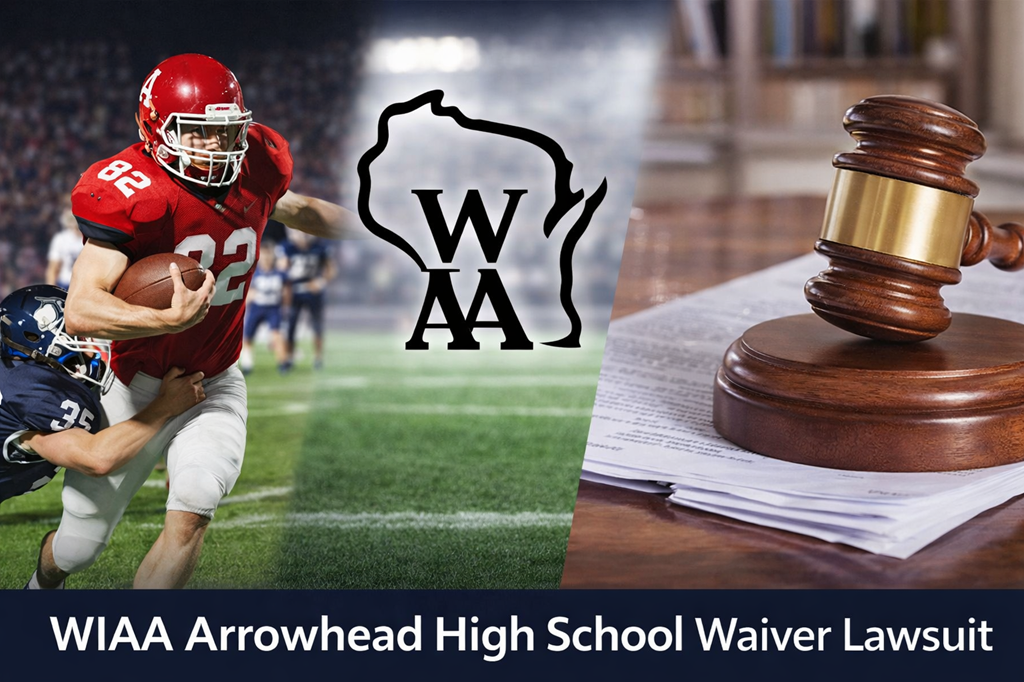
The WIAA Arrowhead High School Waiver Lawsuit is one of the most important legal challenges to Wisconsin high school athletics in recent years. While it began as a dispute over one student’s eligibility, it now raises broader questions about how transfer rules are applied, how hardship is evaluated, and whether a private athletic association can exercise final authority over public school students.
At the center of the case is Tristen Seidl, a senior football player at Arrowhead High School whose transfer followed a prolonged housing emergency caused by a house fire. The lawsuit against the Wisconsin Interscholastic Athletic Association has forced courts to examine the limits of the WIAA’s power and the fairness of its eligibility decisions.
This article explains the case from start to finish. It covers the facts, the legal arguments, the court rulings, and why the outcome could reshape high school sports governance across Wisconsin.
Case Overview: Seidl v. WIAA
The WIAA Arrowhead High School Waiver Lawsuit is a Wisconsin legal case in which the family of student athlete Tristen Seidl sued the Wisconsin Interscholastic Athletic Association after it denied him athletic eligibility following a school transfer caused by a house fire.
- The conflict: Seidl transferred from Kettle Moraine High School after his family’s home became unlivable in 2023.
- The lawsuit: His parents filed suit in Waukesha County Circuit Court on August 19, 2025.
- The injunction: A judge granted a temporary injunction on September 5, 2025, allowing Seidl to play.
- The outcome: Seidl completed the season, and Arrowhead won the Division 1 state championship in November 2025.
- Current status: The case remains active, with a key hearing scheduled for March 3, 2026.
At its core, the lawsuit examines whether a private athletic association can enforce transfer rules on public school students when family hardship is clearly documented.
The WIAA and Its Authority Over Public Schools
The Wisconsin Interscholastic Athletic Association governs interscholastic athletics for more than 500 member schools across the state. Its rules regulate eligibility, transfers, postseason play, and discipline.
Although the WIAA is legally structured as a private organization, its decisions directly affect students enrolled in public schools. For decades, Wisconsin courts have generally reviewed WIAA decisions under a deferential standard, intervening only when a ruling appeared unreasonable or unlawful.
The Arrowhead lawsuit challenges whether that deference should continue when eligibility rules affect educational opportunity and when no statute explicitly grants the WIAA authority to make those determinations.
The Family Emergency Behind the Transfer
A house fire and months of displacement
In October 2023, a fire destroyed the Seidl family’s home in Dousman, Wisconsin. At the time, Tristen was a sophomore attending Kettle Moraine High School.
Contractors initially advised that the home could be repaired. Based on that guidance, the family moved through four temporary residences over the next seventeen months. Throughout that period, Tristen remained enrolled at Kettle Moraine to maintain stability while repairs were expected.
By March 2025, contractors concluded the damage was too severe to fix. The home was demolished in April.
With no residence to return to, the family signed a long-term lease in the Arrowhead High School attendance area and enrolled Tristen there for his senior year.
Both school districts approved the transfer.
The WIAA did not.
Why the WIAA Denied the Transfer Waiver
Under WIAA rules, students who transfer schools are generally barred from varsity competition for one year unless they qualify for specific exceptions.
Two possible exceptions were reviewed:
- Total and complete change of residence
- Extenuating circumstances
The WIAA ruled that Tristen did not meet either standard.
The association focused on timing. Because the family did not immediately transfer Tristen when they first moved into temporary housing within the Arrowhead district, the WIAA concluded that the later enrollment change was not directly required by the fire.
As a result, Tristen was declared ineligible for varsity football during his senior season.
Filing of the WIAA Arrowhead High School Waiver Lawsuit
On August 19, 2025, Tristen’s parents, Blayne and Jenell Seidl, filed suit in Waukesha County Circuit Court.
The legal claims
The lawsuit argued that:
- The WIAA’s decision was arbitrary and capricious, given the documented and prolonged housing emergency.
- The WIAA was unlawfully exercising governmental authority by controlling eligibility decisions for students in public schools without clear legislative authorization.
The family’s attorney contended that nothing in Wisconsin law explicitly grants the WIAA power to determine which public school students may participate in athletics.
The Temporary Injunction That Changed the Season
As the football season began, Tristen sat out the first two games while legal proceedings continued. On September 5, 2025, Judge Paul Bugenhagen Jr. granted a temporary injunction allowing him to play.
Why the court intervened
The court found that Tristen would suffer irreparable harm if he were barred from competition, including:
- Permanent loss of his senior season
- Reduced exposure to college recruiters
- Risk of losing a football scholarship offer from the University of Sioux Falls
The injunction preserved Tristen’s eligibility while the court considered the broader legal issues.
On-Field Results After the Injunction
Once eligible, Tristen played the remainder of the regular season and all postseason games.
Arrowhead High School went on to defeat Bay Port 18-15 in the Division 1 state championship game on November 21, 2025. The championship result stands, and no sanctions have been imposed.
The injunction ensured that Tristen’s senior season was not lost while the legal challenge continued.
December 2025 Ruling: Motion to Dismiss Denied
After the season ended, the WIAA moved to dismiss the lawsuit, arguing that it was moot because Tristen had completed his final year of eligibility.
On December 19, 2025, Judge Bugenhagen denied that request.
Why the case continues
The court ruled that the lawsuit raises unresolved legal questions beyond one athlete. The family continues to seek:
- A declaratory judgment defining the limits of WIAA authority
- Protection for Arrowhead High School from potential penalties
- Judicial clarification on whether the WIAA may enforce transfer rules over public schools
Additional briefing was ordered, and a further hearing was scheduled for March 3, 2026.
The Broader Legal Question at Stake
The central issue in the WIAA Arrowhead High School Waiver Lawsuit is whether the WIAA functions as a state actor when regulating public school athletics.
Wisconsin courts have previously reviewed WIAA decisions but have repeatedly avoided ruling directly on that question. Even cases that reached the Wisconsin Supreme Court stopped short of defining the association’s constitutional status.
A ruling in this case could:
- Increase judicial oversight of eligibility decisions
- Strengthen due process protections for student athletes
- Prompt legislative involvement in high school athletic governance
How This Case Fits Into a Larger Pattern
The Seidl lawsuit follows other recent challenges to WIAA transfer decisions involving family hardship and financial instability. In some cases, the WIAA reversed its decisions before final rulings. In others, courts resolved disputes without addressing authority directly.
The March 2026 hearing may finally force Wisconsin courts to confront the question they have long avoided.
Current Status and What Comes Next
As of early 2026:
- The temporary injunction remains in effect
- Arrowhead’s state championship stands
- The lawsuit is ongoing
- A key hearing is scheduled for March 3, 2026
That hearing is expected to focus directly on whether the WIAA lawfully exercises authority over public school athletic eligibility.
Read More | United Flight UA109 Diversion Explained: What Really Happened
Final Perspective
The WIAA Arrowhead High School Waiver Lawsuit is not about gaining a competitive advantage. It is about how eligibility systems respond when families face prolonged disruption and whether rigid rules can fairly account for real-world hardship.
At its core, the case asks who should have the final say when transfer rules intersect with public education and student opportunity.
The answer may shape high school athletics in Wisconsin for years to come.