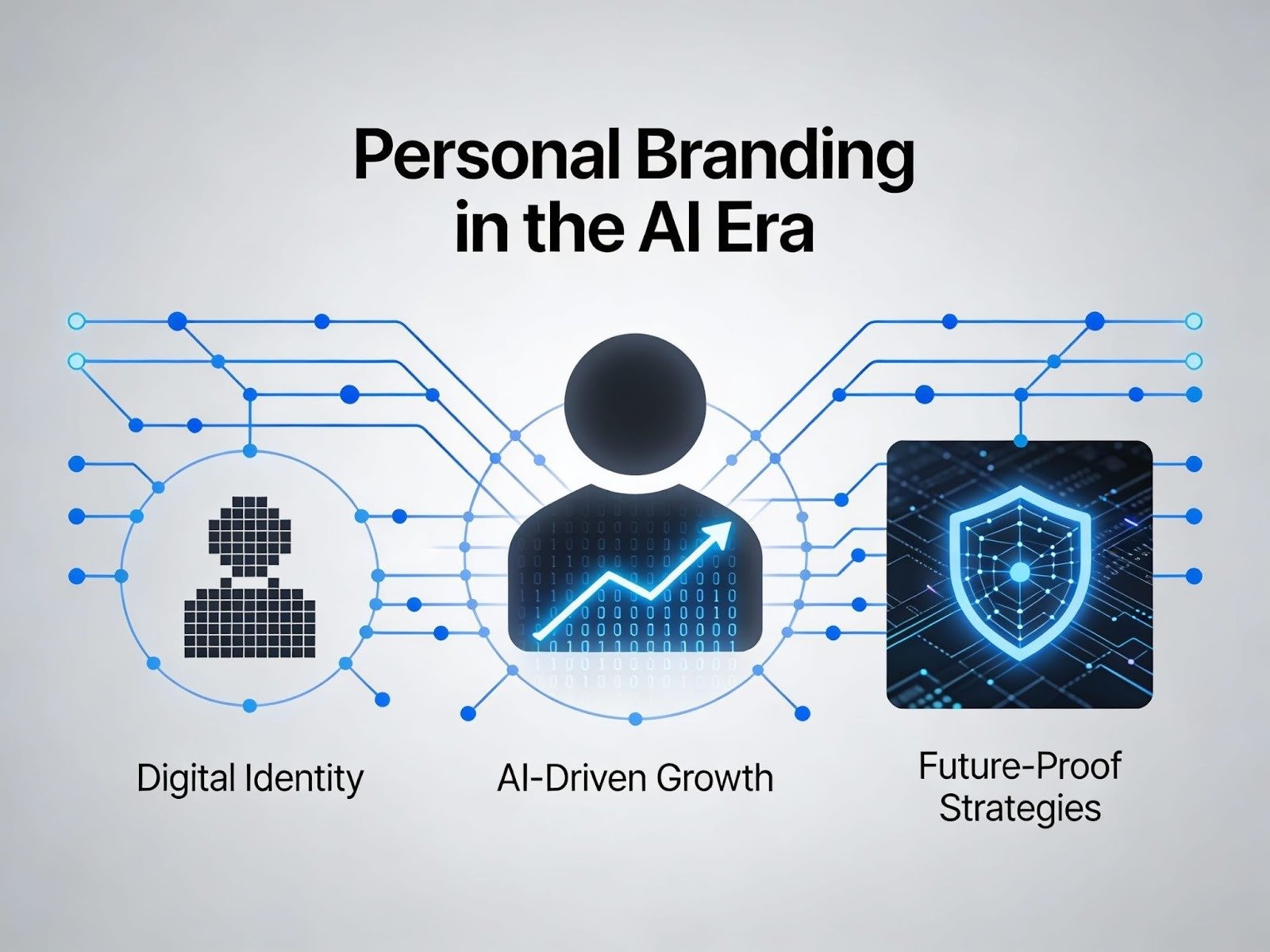
Personal Branding in the AI Era: From Avatars to Digital Twins
The landscape of personal branding has undergone a seismic shift. In an era where artificial intelligence can replicate your voice, recreate your likeness, and even mimic your mannerisms, professionals face both unprecedented opportunities and unsettling challenges.
Your personal brand is no longer confined to a logo, a headshot, or a carefully curated LinkedIn profile—it now extends into the realm of digital replicas that can work, speak, and engage on your behalf.
But with this transformation comes a critical question: In a world where anyone can create a digital version of you, how do you maintain control over your most valuable asset—your personal brand?
AI’s Impact on Personal Branding
The integration of artificial intelligence into personal branding represents more than just a technological upgrade—it’s a paradigm shift in how professionals build, maintain, and leverage their reputation.
Traditional personal branding relied on consistency across platforms, strategic content creation, and authentic engagement. While these principles remain important, AI has introduced new dimensions that fundamentally alter the playing field.
Today’s professionals must consider not just how they present themselves, but how their digital representations—created by themselves or potentially by others—exist in parallel universes across the internet.
The democratization of professional presence stands as one of AI’s most significant impacts. Tools that once required expensive production teams are now accessible to individual professionals. A solopreneur can create professional video content with AI avatars, eliminating the need for camera time, makeup, or perfect lighting. Content creators can maintain 24/7 engagement through AI-powered chatbots trained on their communication style.
Research from MIT’s Center for Collective Intelligence found that 68% of professionals now use some form of AI tool for content creation or personal branding activities. This adoption rate has tripled since 2022, indicating rapid normalization of AI in professional contexts.
Scale and consistency have reached new heights. An executive coach can deliver personalized video messages to hundreds of clients simultaneously. A thought leader can maintain active engagement across multiple platforms without physically being present. Your AI avatar can attend virtual networking events in different time zones while you sleep.
However, this efficiency comes with a trade-off: the potential dilution of authenticity. As AI-generated content becomes ubiquitous, audiences increasingly crave genuine human connection.
The most successful personal brands in the AI era will be those that strategically leverage AI for scale while preserving authentic touchpoints that remind audiences there’s a real person behind the technology.
AI Avatar Tools for Professionals
The market for AI avatar creation has exploded, offering professionals tools ranging from simple profile picture generators to sophisticated digital twins capable of real-time interaction.
Synthesia has emerged as a leader in professional video avatar creation. The platform allows users to create AI avatars that can deliver presentations in over 120 languages. With pricing starting at $29 per month, it’s positioned for individual professionals and small businesses. Users report time savings of up to 80% in video content production compared to traditional filming methods.
HeyGen offers a more personalized approach, creating avatars based on just a few minutes of video footage. The tool captures subtle facial expressions and gestures, producing remarkably lifelike results. Professionals in coaching, consulting, and education have found particular value in HeyGen’s ability to create training materials and course content that maintains a personal touch at scale.
D-ID specializes in bringing still images to life, creating talking avatars from photographs. This tool has found traction among authors, speakers, and historical educators who want to animate archival images or create dynamic presentations from existing headshots.
For real-time interaction, Soul Machines and UneeQ offer digital humans capable of conversational AI, combining avatar technology with natural language processing. These advanced solutions, typically priced for enterprise clients, enable customer service representatives, brand ambassadors, and corporate trainers to maintain a human face while operating at machine scale.
Practical considerations for choosing avatar tools include:
- Video quality and realism level appropriate for your industry
- Customization options for gestures, expressions, and backgrounds
- Integration capabilities with your existing content platforms
- Language and accent options for global reach
- Pricing structure that aligns with your content volume
- Data privacy and usage rights policies
The most sophisticated professionals aren’t choosing just one tool but creating an ecosystem of AI applications that serve different aspects of their personal brand strategy.
Voice Cloning for Content Creation
Your voice carries unique characteristics—pitch, tone, cadence, accent—that form an integral part of your personal brand. AI voice cloning technology now allows professionals to replicate these characteristics with startling accuracy, opening new frontiers in content creation while raising important ethical considerations.
ElevenLabs has set the industry standard for voice cloning quality. With just a few minutes of audio samples, the platform can generate a voice clone capable of reading any text with natural intonation and emotion. Podcasters, audiobook authors, and content creators use ElevenLabs to produce audio content in multiple languages while maintaining their vocal identity.
According to the company’s data, users have created over 1 million voice clones, generating more than 100 million audio files. The professional tier, priced at $99 per month, offers commercial usage rights and higher quality output suitable for professional applications.
Descript’s Overdub takes a different approach, integrating voice cloning directly into an audio editing workflow. This tool excels at making corrections and updates to recorded content without requiring re-recording entire segments. Professionals who create tutorial videos, training materials, or podcast content save countless hours by simply typing corrections rather than returning to the recording booth.
Resemble.AI caters to professionals needing real-time voice synthesis, enabling applications like virtual assistants that sound like you or interactive brand experiences that maintain vocal consistency.
Strategic applications of voice cloning for personal branding include:
- Creating audiobook versions of written content without studio time
- Generating podcast content in multiple languages while maintaining your voice
- Producing consistent audio branding across all platforms
- Correcting mistakes in recorded content efficiently
- Scaling personalized audio messages to clients or audience members
- Maintaining content production during periods of illness or travel
However, voice cloning demands careful ethical consideration. Leading professionals establish clear disclosure policies, informing their audience when content features AI-generated voice rather than live recording. This transparency maintains trust while leveraging technology’s efficiency benefits.
The Likeness Protection Problem
The same technologies that empower professionals to create AI representations also enable bad actors to do so without permission. The likeness protection problem represents one of the most pressing challenges in personal branding’s AI era.
Unauthorized AI Use of Your Image
A 2024 study by the Digital Identity Protection Institute found that 37% of public-facing professionals have discovered unauthorized AI-generated content featuring their likeness. These range from benign fan-created content to malicious impersonations designed to deceive audiences or damage reputations.
The ease of creation poses the primary challenge. Tools like DeepFaceLab, which can swap faces in videos, are freely available online. More sophisticated commercial platforms make unauthorized avatar creation accessible to anyone with basic technical skills and a collection of your publicly available photos and videos.
Common unauthorized use cases include:
- Fake endorsements of products or services you’ve never supported
- Fabricated statements or opinions attributed to you
- Unauthorized use in marketing materials or advertisements
- Creation of faceswapped or undressed content with ai featuring your likeness
- Impersonation for financial fraud or social engineering attacks
The reputational damage can be severe. Business consultant Maria Rodriguez discovered an AI-generated video of her “avatar” endorsing a cryptocurrency scheme. Despite never being involved with cryptocurrency, the realistic video led to client inquiries and damaged her credibility in conservative financial circles.
Deepfake Concerns
Deepfakes—AI-generated synthetic media that convincingly replaces one person’s likeness with another—represent the extreme end of the likeness protection spectrum. While initially emerging as entertainment or political satire, deepfakes have evolved into sophisticated tools for fraud and manipulation.
Research from Deeptrace Labs identified over 96,000 deepfake and adult ai content online as of late 2024, a 330% increase from two years prior. While celebrity targets dominate current statistics, the technology’s democratization means any professional with a substantial online presence faces potential targeting.
Professional risks associated with deepfakes include:
- Fabricated video statements that contradict your actual positions
- Apparent participation in events or activities you never attended
- Fake video calls or conferences that deceive colleagues or clients
- Manufactured scandals designed to destroy professional reputation
- Financial fraud perpetrated using your video likeness
Technology executive Tom Chen experienced this firsthand when deepfake video of him apparently announcing his company’s bankruptcy circulated on social media, causing real stock price fluctuations before the fraud was exposed.
Legal Protections
The legal landscape surrounding likeness protection remains fragmented and evolving. Different jurisdictions offer varying levels of protection, and existing laws often struggle to keep pace with technological advancement.
Right of publicity laws in the United States provide some protection, allowing individuals to control commercial use of their name, image, and likeness. However, these laws vary significantly by state. California and New York offer robust protections, while other states provide minimal coverage. The laws typically apply only to unauthorized commercial use, leaving non-commercial deepfakes and impersonations in legal gray areas.
The NO FAKES Act, proposed federal legislation introduced in 2024, would create a national right protecting individuals against unauthorized digital replicas. If passed, it would establish clearer liability frameworks and provide victims with legal recourse. However, the legislation faces opposition from free speech advocates concerned about potential overreach.
Europe’s approach through the Digital Services Act and AI Act offers more comprehensive protection. These regulations require platforms to implement systems for detecting and removing unauthorized deepfakes and mandate clear labeling of AI-generated content. Professionals operating in European markets benefit from stronger regulatory frameworks.
Practical legal strategies for protecting your likeness include:
- Registering trademarks for your name and signature elements
- Documenting your authorized AI representations through official channels
- Implementing monitoring systems to detect unauthorized use
- Establishing clear terms of use for your publicly available content
- Working with legal counsel to send cease-and-desist notices when violations occur
- Considering cyber insurance policies that cover digital impersonation
Attorney Sarah Williamson, specializing in digital rights, advises: “Don’t wait until you’re a victim to establish protections. Proactive measures create stronger legal positions and demonstrate your intent to control your digital identity.”
Creating Your Official AI Presence
Rather than allowing others to define your AI representation, forward-thinking professionals are taking control by creating official, authorized versions of their digital presence.
Strategic planning should precede any AI avatar creation. Consider these foundational questions:
What purpose will your AI presence serve? Customer service, content delivery, education, networking, or something else? The answer shapes every subsequent decision about tools, style, and implementation.
How much of yourself do you want to replicate? Some professionals create simplified, stylized avatars that represent them without attempting photorealism. Others pursue digital twins that closely mimic their appearance, voice, and mannerisms.
What boundaries will you establish? Define clear use cases where your AI presence operates and situations reserved for your personal involvement. This distinction maintains authenticity while leveraging AI’s efficiency.
Creation process typically involves:
Data collection: Record multiple videos from different angles, in various lighting conditions, and displaying different emotions and expressions. This diversity improves your avatar’s versatility and realism. Similarly, voice cloning requires 30-60 minutes of clean audio samples demonstrating your natural speaking patterns.
Platform selection: Choose tools aligned with your specific needs and budget. Enterprise professionals might justify premium platforms like Hour One or Synthesia, while independent consultants might begin with more accessible options like HeyGen or D-ID.
Training and refinement: Most AI avatar platforms require iterative refinement. Initial results often need adjustment for natural expressions, appropriate gestures, and authentic vocal patterns. Budget time for this refinement process.
Integration planning: Consider how your AI presence integrates with existing platforms. Can it embed in your website? Does it connect with your email marketing? Can it participate in your social media strategy?
Marketing strategist Jennifer Park created a comprehensive AI presence that includes a video avatar for course content, a voice clone for podcast production, and a chatbot trained on her methodology. “The key was maintaining consistency across all representations while clearly distinguishing AI-generated content from my personal appearances,” she explains.
Authentication and verification provide crucial legitimacy. Leading professionals:
- Create official registry pages listing all authorized AI representations
- Use consistent visual or audio watermarks identifying AI-generated content
- Implement verification systems allowing audiences to confirm authenticity
- Partner with blockchain-based identity verification platforms
- Maintain public databases of authorized use cases
This transparency doesn’t diminish AI’s value—it enhances trust by demonstrating ethical implementation and respect for audience intelligence.
Protecting Your Digital Identity
Proactive protection strategies prove far more effective than reactive damage control. Building a robust digital identity defense requires technical, legal, and strategic components.
Monitoring systems form your first line of defense. Several services now specialize in detecting unauthorized use of your likeness:
PimEyes and FaceCheck.ID offer facial recognition tools that scan the internet for images matching your face. While controversial for privacy reasons, these tools help professionals identify unauthorized use quickly.
Brand monitoring platforms like Brandwatch and Mention can be configured to alert you when your name appears in unexpected contexts or on suspicious websites.
Google Alerts provides a free, basic monitoring solution. Set up alerts for your name, common misspellings, and associated keywords to catch potential impersonations early.
Active content management means controlling the raw materials available for AI replication:
- Limit ultra-high-resolution images in public domains
- Watermark professional photos with visible or invisible markers
- Use varied appearances across platforms to make consistent replication harder
- Consider strategic variations in professional photos that serve as authenticity markers
- Maintain private repositories of verified authentic content
Digital identity services offer comprehensive protection packages. Companies like IDShield, Reputation Defender, and Norton LifeLock now include digital likeness protection in their offerings, monitoring for unauthorized AI representations and assisting with removal when violations occur.
Platform-specific protections vary considerably:
LinkedIn now offers verification badges and tools to report impersonation accounts. Use these features proactively rather than waiting for problems to emerge.
YouTube’s Content ID system can be trained to recognize your voice and face, automatically flagging potential unauthorized use in uploaded videos.
Instagram and Facebook provide similar verification and reporting mechanisms, though effectiveness varies.
Community building serves as both protection and early warning system. An engaged audience familiar with your authentic presence quickly identifies and reports suspicious content. Regular interaction, consistent communication style, and transparent practices create a community invested in protecting your legitimate brand.
Response protocols should be established before incidents occur:
- Document discovery immediately with screenshots and archived copies
- Identify the platform hosting unauthorized content
- Attempt direct contact requesting removal
- File formal complaints through platform reporting systems
- Issue public statements clarifying the unauthorized nature
- Pursue legal action for severe or persistent violations
- Update monitoring systems to prevent recurrence
Financial advisor Robert Martinez shares: “When I discovered fake investment advice videos using my AI likeness, my prepared response protocol meant I had the content removed within 48 hours and statements issued to clients within 24. That preparation prevented what could have been a career-ending crisis.”
Future: AI Brand Ambassadors
The trajectory of AI in personal branding points toward increasingly sophisticated digital representatives that don’t just replicate their creators but actively extend their professional capabilities.
Autonomous AI brand ambassadors represent the next evolution. These systems combine avatar technology, voice cloning, natural language processing, and training on your complete body of work to create digital representatives capable of independent decision-making within defined parameters.
Technology analyst Rachel Kim describes this evolution: “We’re moving from AI that repeats what you’ve said to AI that thinks like you think, applying your methodology to new situations and interactions you haven’t explicitly programmed.”
Emerging capabilities being developed include:
Adaptive learning: AI brand ambassadors that observe and incorporate your evolving perspectives, updating their responses based on your latest content and interactions.
Emotional intelligence: Systems capable of reading audience emotions and adjusting communication style accordingly, mirroring how skilled professionals adapt to different interpersonal contexts.
Multi-modal presence: Unified AI identities that operate seamlessly across video, audio, text, and virtual reality environments, maintaining consistent personality across platforms.
Collaborative AI teams: Multiple specialized AI avatars representing different aspects of your expertise, working together to provide comprehensive service while maintaining your personal brand umbrella.
Business model implications are profound. Consultants could offer unlimited client access at scaled pricing, with AI avatars handling routine queries while flagging situations requiring personal intervention. Educators could deliver truly personalized instruction to thousands simultaneously. Thought leaders could maintain continuous global engagement without the physical limitations of time zones and human endurance.
Research firm Gartner predicts that by 2027, 40% of professional service interactions will involve AI brand ambassadors. This doesn’t signal human replacement but rather augmentation—professionals handling high-value, nuanced work while AI representatives manage scale and consistency.
Ethical frameworks become increasingly critical as AI representatives gain autonomy. Leading professionals are establishing:
- Clear disclosure requirements ensuring audiences know when they’re interacting with AI
- Governance systems defining acceptable AI decision-making boundaries
- Regular audits ensuring AI representatives align with current values and positions
- Kill switches allowing immediate deactivation if AI behavior becomes problematic
- Feedback mechanisms enabling audiences to flag concerning AI interactions
The human advantage paradoxically strengthens as AI capabilities expand. The aspects of personal branding that AI cannot replicate—genuine vulnerability, spontaneous creativity, ethical judgment in novel situations, true empathy—become more valuable precisely because they’re rare.
Business philosopher Alain de Botton observes: “In an age of perfect digital replicas, imperfection becomes the ultimate luxury. The unscripted moment, the authentic struggle, the real presence—these become premium experiences in a world of optimized AI interactions.”
Preparing for this future requires professionals to:
Think strategically about which aspects of your professional identity benefit from AI scaling and which require personal delivery. Document your methodology, values, and decision-making frameworks in ways AI systems can learn from. Build trust capital with your audience that allows introduction of AI representatives without authenticity concerns. Stay informed about emerging tools and best practices in AI personal branding. Develop comfort with controlled experimentation, testing AI applications in low-risk scenarios before full implementation.
Conclusion
Personal branding in the AI era demands a fundamental reimagining of professional identity. The technologies enabling unprecedented scale and efficiency also create new vulnerabilities requiring vigilant protection. Success belongs to professionals who embrace this complexity rather than retreating from it.
Your personal brand now exists simultaneously in analog and digital realms, with representations ranging from traditional media to autonomous AI avatars. This multiplicity doesn’t diminish your authentic self—it amplifies your ability to create impact while demanding greater intentionality about what you amplify and how.
The professionals thriving in this landscape share common characteristics: strategic adoption of AI tools aligned with clear purposes, proactive protection of digital identity through monitoring and legal frameworks, transparent communication about AI use that maintains audience trust, continuous learning about emerging technologies and best practices, and preservation of authentic human touchpoints that remind audiences why they connected with you originally.
As you develop your AI-enhanced personal brand, remember that technology serves as an amplifier, not a replacement. Your unique perspective, lived experience, and authentic voice remain irreplaceable. AI simply ensures these valuable assets reach further, work harder, and create greater impact than ever before possible.