From Idea to Launch: a Decoded version of MVP vs. Prototype vs. Beta Release
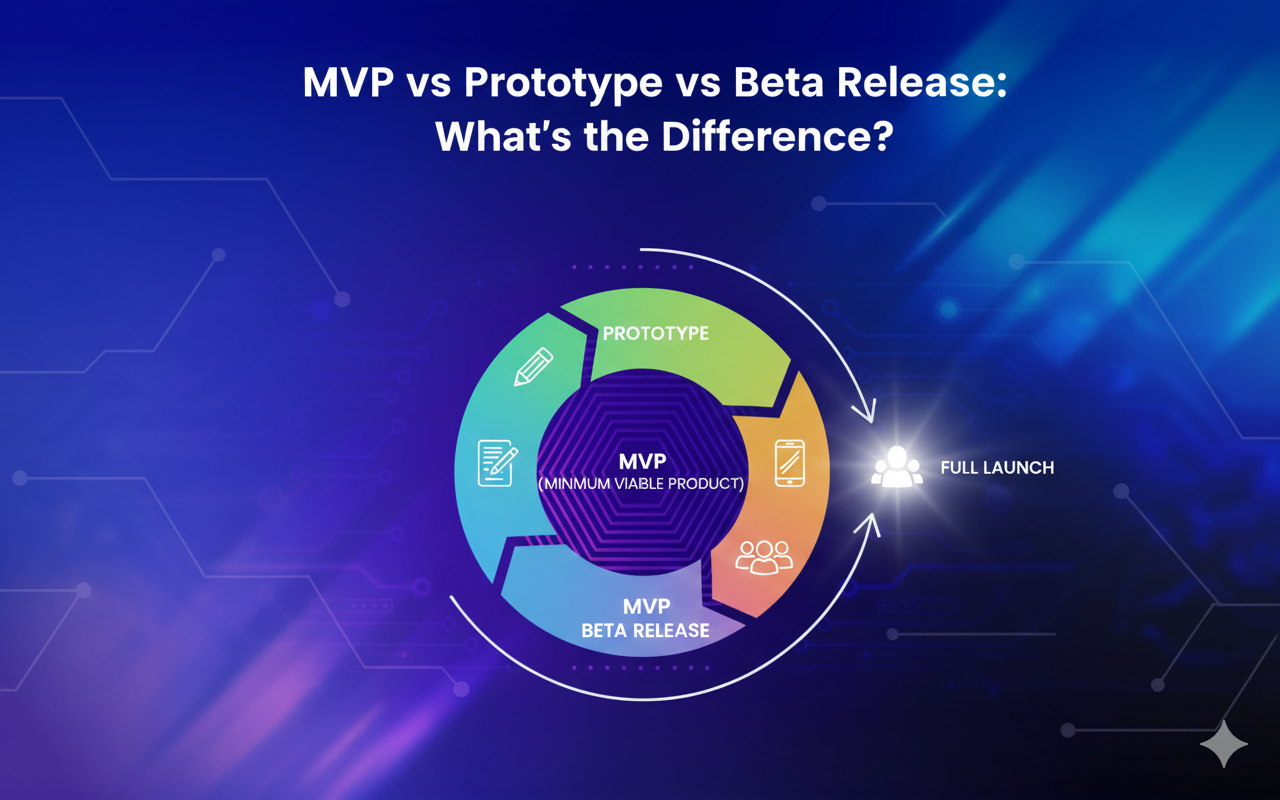
In the fast-paced world of product development, the terms MVP, prototype and beta seem to be talking in tandem with one another. Mixing up the meanings of the three is an open invitation to confusion, misallocated resources, and unmet expectations. You are essentially delineating between checking off a sketch quickly, getting a minimum sellable product, or going for a near-finished version for testing?
Indeed, knowing the difference can sometimes be esoteric but is a strategic superpower. You make certain that everyone—meaningful stakeholders, marketers, developers—understands what the goal is, the scope, and the audience for these different stages of your product’s voyage.
Therefore, it is appropriate to break down these three major phases, free of extraneous noise, and look ahead.
The Quick Comparison Table
Before we dig further, here is a high-level overview that covers the essentials pertinent to each level.
| Feature | Prototype | MVP (Minimum Viable Product) | Beta Release |
| Primary Goal | Validate Feasibility & Design | Validate Market Need & Learn | Validate Stability & Scalability |
| What is it? | A visual or interactive mock-up. | The simplest sellable version of your product. | A feature-complete version for real-world testing. |
| Functionality | Low/Simulated. “Looks like” the product. | Core Function Only. “Works” for one main problem. | High (Nearly All). “Works well” under real load. |
| Audience | Internal team, stakeholders, early user testing. | Early Adopters who pay or provide high-value feedback. | A larger, public or private group of beta testers. |
| Key Question | “Are we building the right thing?” | “Should we build this at all?” | “Did we build this thing right?” |
| Fidelity | Low to High-Fidelity (clickable models) | Live, functional product with basic UI/UX. | Polished product, but may have known minor bugs. |
| Built With | Figma, Sketch, InVision, even paper! | Actual codebase, front-end & back-end. | Robust, scalable codebase. |
| Duration | Days to a few weeks. | A few weeks to a few months. | A few months, leading up to full launch. |
Deep Dive: The Prototype
What is it?
A prototype is the simulation of your end go-to-market product. It is essentially a tangible form of the final product developed to get the idea and roll out early stages of testing to a point where the velocity resorts to code. Its blueprint is equivalent to the architectural plan for the house where you can’t live.
Key Characteristics:
- Focus on ‘feel and flow’. It is everything regarding user experience and interface. How intuitive are the navigation and the workflow experienced by the user?
- Non-Functional: You can’t process an actual payment or save real data on a mockup. The buttons may be clicked to navigate to another page, but no real-time action is taken in the background.
- Achieving low-cost fast failure is the real objective. This philosophy of rapid iteration is what a professional mvp development company embeds at every stage.
When to Use It:
- To pitch an idea to investors or stakeholders.
- To conduct usability tests with a small group of users.
- To align your design and development teams on the product’s vision.
Analogy: A chef’s sketch of a new dish, showing plating and ingredients, before buying any groceries or lighting the stove.
Deep Dive: The MVP (Minimum Viable Product)
What is it?
MVP is one of the most misinterpreted concepts, even as it doesn’t mean half-baked or low-quality products. Eric Rowe defines MVP in his book The Lean Startup as that version of a new product which allows the team to collect the maximum amount of validated learning about their customers with the least effort.
The simplest possible product that has been developed to the point where it actually works and delivers some share of the emergent value to early adopters in a time box that must allow for maximum user learning, but within which no further product development is considered until the MVP is validated for complete value or is invalidated.
Key Characteristics:
- Addresses a Purpose Simple: Focuses on one value proposition. The M. V. P. of a rideshare app. would be “Request a ride -> Get a ride -> Pay.” No loyalty programmes, no picking up a fancy car.
- Functioning & Out: Very simple: it’s a product that works and serves its requirements with technology. You sign up, do some core jobs, and get real input.
- Designed for Feedback: Feedback you capture should be about the business hypothesis, not just the design. “Does this have market value? Will anybody pay for it?” “Does this solve people’s pain point?”
When to Use It:
- To test your fundamental business hypothesis in the real market.
- To attract your first set of early adopters.
- To establish a feedback loop that will guide all future development.
Innovative Cuisine: Food Truck. It serves minimalist cuisine (core features) in order to test the market (value proposition) so it can prepare for crowdfunding for a brick-and-mortar restaurant with full service (full product).
Deep Dive: The Beta Release
What is it?
Beta release means that the final product was released to a larger audience that was not in your company to break bugs and see how it performed in real-world reality. It’s considered the final examination before the official launch.
Key Characteristics:
- Feature complete in the strictest sense: all the core features dreamed of for V1 have been coded and integrated.
- Shift to Quality/Performance: It’s no longer a question of what to build, but how well it is built. The conversation is about stress testing of the server, debug averages, security holes, and more.
- Utilization in the Real World: Real people use the devices with data, revealing problems in the real world that aren’t dreamed of in factory test combinations.
Types of Beta Releases:
- Classified Beta: Open to an invitation-only group for a time. This is more well-organised.
- Public Beta: Not until many folks have had the opportunity to interact with or examine the software product. This is also a clever machination to create some noise.
When to Use It:
- When the core product is all done, just testing in-house.
- The load test is done to validate stability with live traffic.
- Finally, neatness has been achieved by extinguishing critical bugs prior to commercial deployment.
Think of the soft opening for a brand new restaurant. The menu is set, the staff is hired, and so on. The public will come in to sort out the small issues with service, kitchen time, and customer experience before the grand opening.
The Seamless Journey: How They Work Together
These three stages are not isolated; they form a powerful, iterative pipeline for building successful products. This holistic process is what defines modern product engineering solutions, where each stage informs and de-risks the next.
Let’s illustrate with Instagram’s (hypothetical) journey:
- Prototype: Founders create a mock-up app that they name as “Burbn”. It has a check-in screen, a photo upload button, and a social feed. They let their friends use it and check to see if the flow makes sense.
- MVP: They realize the photo-sharing part is the most engaging. They build a working app that does just one thing: allow users to share a photo with a filter. No explore page, no DMs, no stories. They release it to a small group. The feedback is overwhelming: people love the simple photo-sharing. This is the validated learning.
- Beta: They then go on to build the full V1 product that incorporates profiles, feeds, likes, and comments. They release the app as a “Beta” on the App Store, where there is a wider audience. They collect data from crash reports, server stats, and user interaction in order to fix bugs and improve the app.
- Full Launch: Due to the relative success of the Beta, Instagram is officially launched to the rest of the world.
Common Pitfalls to Avoid
- Not Transitioning From Prototype to MVP: Never fall in love with your prototype–it is a learning tool. Therefore, you must get prepared to pivot based on the prototype’s feedback.
- Too Many Features in an MVP (The “Minimum Lovable Product” Trap): The MVP should be viable, not perfect. Remember, the Deployment phase will be delayed due to the addition of features that may complicate the issue. How can you hope to learn what the customer really needs in this way?
- Skipping Beta Testing: An MVP without a comprehensive beta is sure to result in a public failure rather than a well-closed bug or performance issue discovered via beta testing.
Conclusion: Clarity Leads to Better Products
The understanding of what a Prototype was, what an MVP is, and what a Beta Release means is fundamental to the development of products these days.
- Created a Prototype – Can you show that, we are doing the right things?
- MVP-Might it be better to follow up on this question?
- Beta Release-Says, “Have we done it right?”
Through the correct usage of these roles, one moves away from danger by responding to the likelihood of many mistakes. One will leave behind the culture of developers making guesses
and crossing their fingers about how to trick customers into paying for it!
Author Name: Azhar Shaikh
Author Bio: Azhar, the Strategy & Consulting Manager at Bytes Technolab Saudi Arabia, specialises in digital transformation and product engineering. With over a decade of consulting experience, he has guided 200+ clients across the EMEA region, helping them modernise systems, boost efficiency, and achieve significant revenue growth. His expertise in AI and innovative solutions empowers businesses to stay competitive and drive sustainable success.